Ch. 19 The Cardiovascular System: Blood Vessels
Marieb - Human Anatomy & Physiology 11th Edition
Marieb, Hoehn11th EditionHuman Anatomy & PhysiologyISBN: 9780136874034당신이 사용하는 게 아니라요?교과서 변경
19장, 문제 10

Using the letters from column B, match the artery descriptions in column A. (Note that some require more than a single choice.)
Column A 
____  (1) unpaired branch of abdominal aorta 
____  (2) second branch of aortic arch 
____ 3) branch of internal carotid 
____ (4) branch of external carotid 
____  (5) origin of femoral arteries
Column B
a. right common carotid
b. superior mesenteric
c. left common carotid
d. external iliac
e. inferior mesenteric
f. superficial temporal
g. celiac trunk
h. facial
i. ophthalmic
j. internal iliac

검증된 단계별 안내
1
Step 1: Identify the unpaired branches of the abdominal aorta. Recall that the abdominal aorta gives off three major unpaired branches: the celiac trunk, the superior mesenteric artery, and the inferior mesenteric artery. From the options, these correspond to letters g (celiac trunk), b (superior mesenteric), and e (inferior mesenteric).
Step 2: Determine the second branch of the aortic arch. The aortic arch typically gives off three branches in order: the brachiocephalic trunk (which divides into the right common carotid and right subclavian), the left common carotid artery, and the left subclavian artery. Therefore, the second branch is the left common carotid artery, which corresponds to letter c.
Step 3: Identify a branch of the internal carotid artery. The internal carotid artery gives off several branches, one of which is the ophthalmic artery. From the list, the ophthalmic artery corresponds to letter i.
Step 4: Identify a branch of the external carotid artery. The external carotid artery has several branches including the facial artery (h) and the superficial temporal artery (f). Both are branches of the external carotid, so both letters h and f apply here.
Step 5: Determine the origin of the femoral arteries. The femoral arteries are continuations of the external iliac arteries after they pass under the inguinal ligament. Therefore, the origin corresponds to the external iliac artery, letter d.

비슷한 문제에 대한 검증된 영상 답변:

이 영상 해법은 위 문제에 도움이 된다고 튜터들이 추천한 것입니다.
영상 길이:
2m
도움이 되었나요?

주요 개념

질문에 올바르게 답하기 위해 반드시 이해해야 하는 핵심 개념들은 다음과 같습니다.

Anatomy of the Aortic Arch and Its Branches

The aortic arch gives rise to major arteries supplying the head and upper limbs. Typically, the first branch is the brachiocephalic trunk, the second is the left common carotid artery, and the third is the left subclavian artery. Understanding this order helps identify arteries originating from the aortic arch.
추천 영상:
3:20
The Vagina

Branches of the Abdominal Aorta

The abdominal aorta gives off several unpaired branches that supply the digestive organs, including the celiac trunk, superior mesenteric artery, and inferior mesenteric artery. Recognizing these arteries is essential for matching descriptions of unpaired branches.
추천 영상:
가이드 코스
13:34
Cardiac Cycle: Putting It All Together

Branches of the Carotid Arteries

The common carotid artery bifurcates into internal and external carotid arteries. The internal carotid artery supplies the brain and gives off branches like the ophthalmic artery, while the external carotid artery supplies the face and scalp with branches such as the facial and superficial temporal arteries.
추천 영상:
14:43
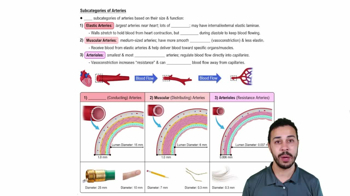
Subcategories of Arteries