Ch. 19 The Cardiovascular System: Blood Vessels
Marieb - Human Anatomy & Physiology 11th Edition
Marieb, Hoehn11th EditionHuman Anatomy & PhysiologyISBN: 9780136874034당신이 사용하는 게 아니라요?교과서 변경
19장, 문제 1

Which statement does not accurately describe veins?
a. Have less elastic tissue and smooth muscle than arteries.
b. Contain more fibrous tissue than arteries.
c. Most veins in the extremities have valves.
d. Always carry oxygen-poor blood.

검증된 단계별 안내
1
Step 1: Understand the structural differences between veins and arteries. Veins generally have less elastic tissue and smooth muscle compared to arteries, which allows them to be more flexible but less muscular.
Step 2: Recognize that veins contain more fibrous tissue than arteries. This fibrous tissue helps provide structural support to veins, especially since they operate under lower pressure than arteries.
Step 3: Know that most veins in the extremities have valves. These valves prevent the backflow of blood and assist in returning blood to the heart against gravity.
Step 4: Analyze the statement about oxygen content in veins. While many veins carry oxygen-poor blood, there are exceptions, such as the pulmonary veins, which carry oxygen-rich blood from the lungs to the heart.
Step 5: Based on these points, identify which statement is inaccurate by comparing each option to the known characteristics of veins.

비슷한 문제에 대한 검증된 영상 답변:

이 영상 해법은 위 문제에 도움이 된다고 튜터들이 추천한 것입니다.
영상 길이:
1m
도움이 되었나요?

주요 개념

질문에 올바르게 답하기 위해 반드시 이해해야 하는 핵심 개념들은 다음과 같습니다.

Structural Differences Between Veins and Arteries

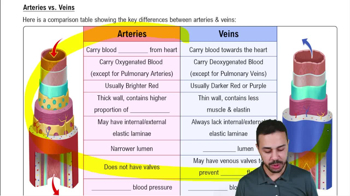
Veins and arteries differ in their wall composition; veins have thinner walls with less elastic tissue and smooth muscle compared to arteries, making them more flexible but less resilient to pressure. This structural difference affects their function and ability to handle blood flow.
추천 영상:
가이드 코스
7:42
Arteries vs. Veins

Presence and Function of Valves in Veins

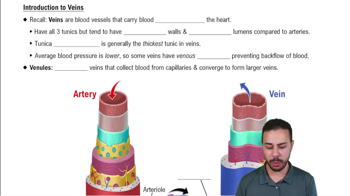
Many veins, especially in the extremities, contain valves that prevent the backflow of blood and assist in returning blood to the heart against gravity. These valves are crucial for maintaining unidirectional blood flow in low-pressure venous systems.
추천 영상:
가이드 코스
6:24
Introduction to Veins

Oxygen Content in Veins

Veins typically carry oxygen-poor blood from the body back to the heart, except for pulmonary veins which carry oxygen-rich blood from the lungs to the heart. Understanding this exception is key to accurately describing venous blood flow.
추천 영상:
가이드 코스
6:24
Introduction to Veins