Define immunocompetence and self-tolerance. How is self-tolerance achieved?
Ch. 21 The Immune System: Innate and Adaptive Body Defenses

21장, 문제 14
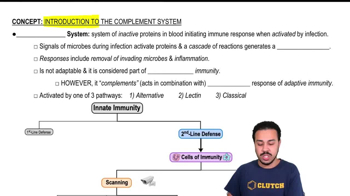
What is complement? How does it cause bacterial lysis? What are some of the other roles of complement?
검증된 단계별 안내1
Understand that the complement system is a group of plasma proteins that work together to enhance the immune response, particularly by targeting pathogens like bacteria.
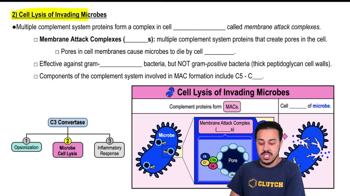
Learn that complement causes bacterial lysis primarily through the formation of the Membrane Attack Complex (MAC), which creates pores in the bacterial cell membrane, leading to cell rupture.
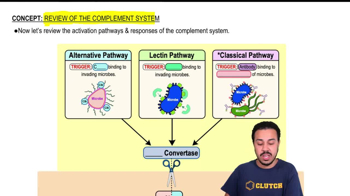
Recognize the sequence of complement activation pathways (classical, lectin, and alternative) that converge to activate the complement cascade and ultimately form the MAC.
Explore other roles of complement, such as opsonization, where complement proteins coat pathogens to enhance phagocytosis by immune cells.
Consider additional functions like promoting inflammation by attracting immune cells to the site of infection and clearing immune complexes and damaged cells from the body.

비슷한 문제에 대한 검증된 영상 답변:
이 영상 해법은 위 문제에 도움이 된다고 튜터들이 추천한 것입니다.
영상 길이:
5m도움이 되었나요?
주요 개념
질문에 올바르게 답하기 위해 반드시 이해해야 하는 핵심 개념들은 다음과 같습니다.
Complement System
The complement system is a group of proteins in the blood that work together to fight infections. It enhances the ability of antibodies and immune cells to clear microbes and damaged cells, promoting inflammation and attacking the pathogen's membrane.
추천 영상:
가이드 코스
Complement System
Mechanism of Bacterial Lysis by Complement
Complement causes bacterial lysis primarily through the formation of the Membrane Attack Complex (MAC), which creates pores in the bacterial cell membrane. This disrupts the membrane integrity, leading to cell swelling and rupture, effectively killing the bacteria.
추천 영상:
가이드 코스
Cell Lysis of Invading Microbes
Other Roles of Complement
Beyond bacterial lysis, complement aids in opsonization, marking pathogens for phagocytosis, and promotes inflammation by attracting immune cells to infection sites. It also helps clear immune complexes and apoptotic cells, maintaining immune system balance.
추천 영상:
가이드 코스
Review of the Complement System
관련 실천
교과서 질문
1514
views
교과서 질문
The cell type most often invaded by HIV is a(n):
a. Eosinophil
b. Cytotoxic T cell
c. Natural killer cell
d. Helper T cell
e. B cell
97
views
교과서 질문
Besides acting as mechanical barriers, the skin epidermis and mucosae of the body have other attributes that contribute to their protective roles. Cite the common body locations and the importance of mucus, lysozyme, keratin, acid pH, and cilia.
977
views
교과서 질문
Differentiate between a primary and a secondary immune response. Which is more rapid and why?
1354
views
교과서 질문
Interferons are referred to as antiviral proteins. What stimulates their production, and how do they protect uninfected cells? Which cells of the body secrete interferons?
1238
views
교과서 질문
Name the five antibody classes and describe where each is most likely to be found in the body.
1219
views
1
rank