Ch. 22 The Respiratory System
Marieb - Human Anatomy & Physiology 11th Edition
Marieb, Hoehn11th EditionHuman Anatomy & PhysiologyISBN: 9780136874034당신이 사용하는 게 아니라요?교과서 변경
22장, 문제 16

Differentiate clearly between minute ventilation and alveolar ventilation rate
Which provides a more accurate measure of ventilatory efficiency, and why?

검증된 단계별 안내
1
Step 1: Define minute ventilation (\( \dot{V}_E \)) as the total volume of air inhaled or exhaled from the lungs per minute. It is calculated by multiplying the tidal volume (the volume of air per breath) by the respiratory rate (breaths per minute): \(\dot{V}_E = V_T \times f\) where \( V_T \) is tidal volume and \( f \) is respiratory rate.
Step 2: Define alveolar ventilation rate (\( \dot{V}_A \)) as the volume of air per minute that actually reaches the alveoli and participates in gas exchange. This accounts for the fact that some air remains in the anatomical dead space and does not contribute to gas exchange. It is calculated as: \(\dot{V}_A = (V_T - V_D) \times f\) where \( V_D \) is the dead space volume.
Step 3: Explain the key difference: minute ventilation measures total air movement in and out of the lungs, including air that does not reach the alveoli, while alveolar ventilation rate measures only the effective ventilation that participates in oxygen and carbon dioxide exchange.
Step 4: Discuss which measure provides a more accurate assessment of ventilatory efficiency. Since alveolar ventilation accounts for dead space and reflects the actual volume of air involved in gas exchange, it is a more precise indicator of how effectively the lungs are ventilating.
Step 5: Summarize that alveolar ventilation rate is preferred for evaluating ventilatory efficiency because it directly relates to the volume of fresh air reaching the alveoli, which is critical for maintaining proper blood gas levels.

비슷한 문제에 대한 검증된 영상 답변:

이 영상 해법은 위 문제에 도움이 된다고 튜터들이 추천한 것입니다.
영상 길이:
2m
도움이 되었나요?

주요 개념

질문에 올바르게 답하기 위해 반드시 이해해야 하는 핵심 개념들은 다음과 같습니다.

Minute Ventilation

Minute ventilation is the total volume of air inhaled or exhaled from the lungs per minute. It is calculated by multiplying the tidal volume (air per breath) by the respiratory rate (breaths per minute). This measure includes both air that participates in gas exchange and air that remains in dead space.
추천 영상:
가이드 코스
8:04
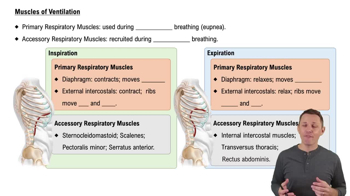
Muscles of Ventilation

Alveolar Ventilation Rate

Alveolar ventilation rate refers to the volume of air per minute that actually reaches the alveoli and participates in gas exchange. It is calculated by subtracting the dead space volume from the tidal volume and then multiplying by the respiratory rate. This measure reflects the effective ventilation of the lungs.
추천 영상:
가이드 코스
8:04
Muscles of Ventilation

Ventilatory Efficiency

Ventilatory efficiency indicates how effectively the lungs exchange gases, primarily oxygen and carbon dioxide. Alveolar ventilation rate provides a more accurate measure of this efficiency because it accounts only for air involved in gas exchange, unlike minute ventilation which includes dead space air that does not contribute to oxygenation.
추천 영상:
02:52
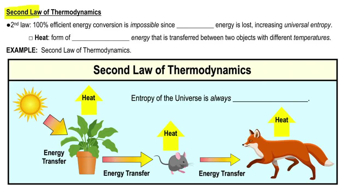
Second Law of Thermodynamics