Ch. 24 Nutrition, Metabolism, and Energy Balance
Marieb - Human Anatomy & Physiology 11th Edition
Marieb, Hoehn11th EditionHuman Anatomy & PhysiologyISBN: 9780136874034당신이 사용하는 게 아니라요?교과서 변경
24장, 문제 10

Transamination is a chemical process by which:
a. Protein is synthesized
b. An amine group is transferred from an amino acid to a keto acid
c. An amine group is split from the amino acid
d. Amino acids are broken down for energy

검증된 단계별 안내
1
Understand the term 'transamination': Transamination is a biochemical process where an amine group (-NH2) is transferred from one molecule, typically an amino acid, to another molecule, usually a keto acid. This process is crucial in amino acid metabolism.
Identify the key molecules involved: Amino acids are organic compounds containing an amine group (-NH2), a carboxyl group (-COOH), and a side chain specific to each amino acid. Keto acids are organic compounds that contain a ketone group (-C=O) and a carboxyl group (-COOH).
Recognize the purpose of transamination: This process allows the body to synthesize non-essential amino acids by transferring amine groups to keto acids, forming new amino acids. It is a reversible reaction catalyzed by enzymes called transaminases or aminotransferases.
Compare the options provided: Analyze each option to determine which one accurately describes transamination. For example, protein synthesis involves linking amino acids into polypeptides, which is unrelated to transamination. Similarly, splitting an amine group or breaking down amino acids for energy are distinct processes like deamination or catabolism.
Conclude that the correct description of transamination is the transfer of an amine group from an amino acid to a keto acid, as this matches the biochemical definition and function of the process.

비슷한 문제에 대한 검증된 영상 답변:

이 영상 해법은 위 문제에 도움이 된다고 튜터들이 추천한 것입니다.
영상 길이:
1m

주요 개념

질문에 올바르게 답하기 위해 반드시 이해해야 하는 핵심 개념들은 다음과 같습니다.

Transamination

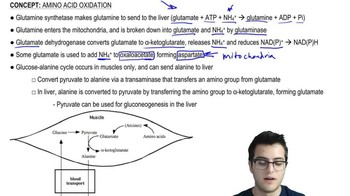
Transamination is a biochemical process that involves the transfer of an amino group from an amino acid to a keto acid. This reaction is crucial for the synthesis of non-essential amino acids and plays a significant role in amino acid metabolism. It allows the body to convert amino acids into different forms, facilitating various metabolic pathways.

Amino Acids

Amino acids are organic compounds that serve as the building blocks of proteins. They contain an amino group, a carboxyl group, and a unique side chain that determines their properties. In transamination, amino acids can donate their amino groups to keto acids, which is essential for maintaining the balance of amino acids in the body.
추천 영상:
가이드 코스
11:42
Amino Acid Oxidation 2

Keto Acids

Keto acids are organic acids that contain a carbonyl group (C=O) and are involved in various metabolic processes, including the Krebs cycle. In the context of transamination, keto acids receive amino groups from amino acids, transforming them into new amino acids. This process is vital for energy production and the synthesis of biomolecules.
추천 영상: