Ch. 24 Nutrition, Metabolism, and Energy Balance
Marieb - Human Anatomy & Physiology 11th Edition
Marieb, Hoehn11th EditionHuman Anatomy & PhysiologyISBN: 9780136874034당신이 사용하는 게 아니라요?교과서 변경
24장, 문제 5

What is formed during aerobic respiration when electrons are passed down the electron transport chain?
a. Oxygen
b. Water
c. Glucose
d. NADH + H⁺

검증된 단계별 안내
1
Understand the process of aerobic respiration: Aerobic respiration is a metabolic pathway where glucose is broken down in the presence of oxygen to produce ATP, carbon dioxide, and water. The electron transport chain (ETC) is the final stage of this process.
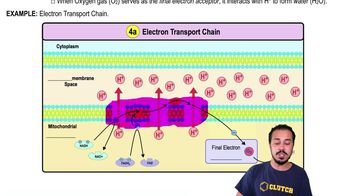
Learn the role of the electron transport chain: The ETC is located in the inner mitochondrial membrane. Electrons are passed down a series of protein complexes and carriers, releasing energy that is used to pump protons (H⁺) across the membrane, creating a proton gradient.
Identify the final electron acceptor: At the end of the electron transport chain, oxygen acts as the final electron acceptor. Oxygen combines with electrons and protons (H⁺) to form water (H₂O).
Understand the chemical reaction: The reaction at the end of the ETC can be represented as: O2+4e+4H+2H2O. This reaction produces water as a byproduct of aerobic respiration.
Eliminate incorrect options: Oxygen is the final electron acceptor, not the product. Glucose is the initial substrate, not formed during this stage. NADH + H⁺ donates electrons to the ETC but is not formed here. Therefore, water is the correct answer.

비슷한 문제에 대한 검증된 영상 답변:

이 영상 해법은 위 문제에 도움이 된다고 튜터들이 추천한 것입니다.
영상 길이:
2m

주요 개념

질문에 올바르게 답하기 위해 반드시 이해해야 하는 핵심 개념들은 다음과 같습니다.

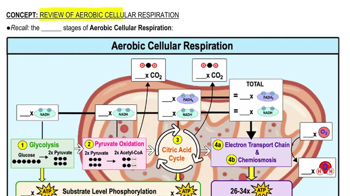
Aerobic Respiration

Aerobic respiration is a metabolic process that uses oxygen to convert glucose into energy, primarily in the form of ATP. This process occurs in the mitochondria of cells and involves several stages, including glycolysis, the Krebs cycle, and the electron transport chain. It is essential for producing energy in organisms that require oxygen.
추천 영상:
가이드 코스
07:51
Review of Aerobic Cellular Respiration

Electron Transport Chain (ETC)

The electron transport chain is a series of protein complexes located in the inner mitochondrial membrane that facilitate the transfer of electrons derived from NADH and FADH2. As electrons move through the chain, they release energy, which is used to pump protons across the membrane, creating a proton gradient that drives ATP synthesis. This process is crucial for the efficient production of ATP during aerobic respiration.
추천 영상:
가이드 코스
07:41
Electron Transport Chain

Water Formation

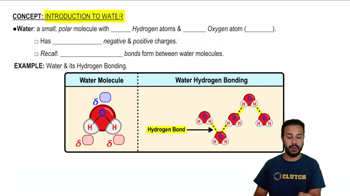
During aerobic respiration, particularly in the electron transport chain, oxygen acts as the final electron acceptor. When electrons combine with oxygen and protons (H⁺), water (H₂O) is formed as a byproduct. This reaction is vital for maintaining the flow of electrons through the chain and is essential for the overall efficiency of aerobic respiration.
추천 영상:
가이드 코스
01:54
Introduction to Water