Ch. 25 The Urinary System
Marieb - Human Anatomy & Physiology 11th Edition
Marieb, Hoehn11th EditionHuman Anatomy & PhysiologyISBN: 9780136874034당신이 사용하는 게 아니라요?교과서 변경
25장, 문제 14

Describe what is involved in active and passive tubular reabsorption.

검증된 단계별 안내
1
Step 1: Understand that tubular reabsorption is the process by which substances are moved from the filtrate in the renal tubules back into the blood in the peritubular capillaries, helping the body retain essential molecules and maintain homeostasis.
Step 2: Define passive tubular reabsorption as the movement of substances down their concentration or electrochemical gradients without the use of cellular energy (ATP). This typically involves diffusion or osmosis of molecules like water, urea, and some ions.
Step 3: Define active tubular reabsorption as the process that requires energy (usually ATP) to move substances against their concentration gradient. This involves specific transport proteins or pumps in the tubular cell membranes, such as the sodium-potassium pump.
Step 4: Explain that active reabsorption is crucial for reclaiming important solutes like glucose, amino acids, and ions (e.g., sodium, calcium), which are often moved via carrier-mediated transport mechanisms.
Step 5: Summarize that both active and passive reabsorption work together in different segments of the nephron to efficiently recover water and solutes, ensuring the body maintains fluid and electrolyte balance.

비슷한 문제에 대한 검증된 영상 답변:

이 영상 해법은 위 문제에 도움이 된다고 튜터들이 추천한 것입니다.
영상 길이:
1m
도움이 되었나요?

주요 개념

질문에 올바르게 답하기 위해 반드시 이해해야 하는 핵심 개념들은 다음과 같습니다.

Active Tubular Reabsorption

Active tubular reabsorption is the process by which substances are transported from the renal tubule back into the blood using energy, typically ATP. This mechanism allows the kidney to selectively reclaim essential molecules like glucose, amino acids, and ions against their concentration gradients.
추천 영상:
4:06
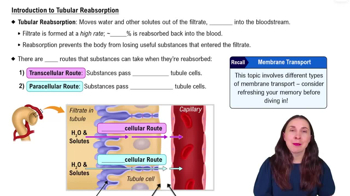
Introduction to Tubular Reabsorption

Passive Tubular Reabsorption

Passive tubular reabsorption occurs without the use of cellular energy, relying on diffusion or osmosis to move substances down their concentration or electrochemical gradients. Water and some solutes like urea are commonly reabsorbed passively in the renal tubules.
추천 영상:
4:06
Introduction to Tubular Reabsorption

Renal Tubule Structure and Function

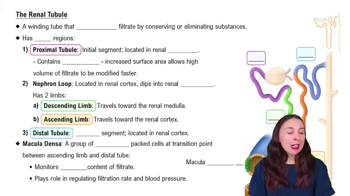
The renal tubule is a part of the nephron where filtrate is processed into urine. Its segments, including the proximal tubule, loop of Henle, distal tubule, and collecting duct, have specialized roles in reabsorbing water and solutes, which is essential for maintaining body fluid balance and homeostasis.
추천 영상:
4:21
The Renal Tubule