Ch. 25 The Urinary System
Marieb - Human Anatomy & Physiology 11th Edition
Marieb, Hoehn11th EditionHuman Anatomy & PhysiologyISBN: 9780136874034당신이 사용하는 게 아니라요?교과서 변경
25장, 문제 22

Explain why the filtrate becomes hypotonic as it flows through the ascending limb of the nephron loop. Also explain why the filtrate at the bend of the nephron loop (and the interstitial fluid of the deep portions of the medulla) is hypertonic.

검증된 단계별 안내
1
Understand that the nephron loop (Loop of Henle) has two distinct segments: the descending limb and the ascending limb, each with different permeability properties affecting filtrate concentration.
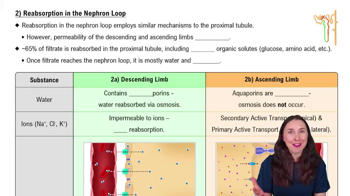
Recognize that the ascending limb of the nephron loop is impermeable to water but actively transports sodium (Na\+), potassium (K\+), and chloride (Cl\-) ions out of the filtrate into the surrounding interstitial fluid.
Because water cannot follow the ions out of the ascending limb, the removal of these solutes decreases the osmolarity of the filtrate, making it hypotonic relative to the plasma.
At the bend of the nephron loop (the tip of the loop), the filtrate has lost water in the descending limb but has not yet lost solutes in the ascending limb, so it becomes highly concentrated, or hypertonic.
The interstitial fluid in the deep medulla is hypertonic due to the accumulation of solutes actively transported from the ascending limb and the countercurrent multiplier system, which establishes a high osmolarity gradient essential for water reabsorption in the collecting ducts.

비슷한 문제에 대한 검증된 영상 답변:

이 영상 해법은 위 문제에 도움이 된다고 튜터들이 추천한 것입니다.
영상 길이:
1m
도움이 되었나요?

주요 개념

질문에 올바르게 답하기 위해 반드시 이해해야 하는 핵심 개념들은 다음과 같습니다.

Function of the Ascending Limb of the Nephron Loop

The ascending limb of the nephron loop actively transports sodium and chloride ions out of the filtrate into the surrounding interstitial fluid but is impermeable to water. This ion removal without water following causes the filtrate to lose solutes while retaining water, making it hypotonic as it ascends.
추천 영상:
3:25
2) Reabsorption in the Nephron Loop

Countercurrent Multiplier Mechanism

The countercurrent multiplier system in the nephron loop creates a concentration gradient in the medulla by moving ions out of the ascending limb and allowing water to leave the descending limb. This mechanism concentrates solutes in the deep medulla, resulting in hypertonic interstitial fluid and filtrate at the loop's bend.
추천 영상:
3:02
Internal Regulation - The Myogenic Mechanism

Osmolarity Changes Along the Nephron Loop

Osmolarity varies along the nephron loop due to selective permeability: the descending limb is permeable to water but not solutes, concentrating filtrate, while the ascending limb removes solutes without water, diluting filtrate. This creates a hypertonic environment at the loop's bend and hypotonic filtrate in the ascending limb.
추천 영상:
3:25
2) Reabsorption in the Nephron Loop
관련 실천
교과서 질문

Patty, aged 55, is awakened by excruciating pain that radiates from her right abdomen to the loin and groin regions on the same side. The pain is not continuous but recurs at intervals of 3 to 4 minutes. Diagnose her problem, and cite factors that might favor its occurrence.

767
views
교과서 질문

Trace the pathway a creatinine molecule takes from a glomerulus to the urethra. Name every microscopic or gross structure it passes through on its journey.

1268
views
1
rank
교과서 질문

Explain the important differences between blood plasma and glomerular filtrate, and relate the differences to the structure of the filtration membrane.

1869
views
교과서 질문

While repairing a frayed utility wire, Kevin, an experienced lineman, slips and falls to the ground. Medical examination reveals a fracture of his lower spine and transection of the lumbar region of the spinal cord. How will Kevin's micturition be controlled from this point on? Will he ever again feel the need to void? Will there be dribbling of urine between voidings? Explain the reasoning behind all your responses.

669
views
교과서 질문

Mrs. Bigda, a 60-year-old woman, was brought to the hospital by the police after falling to the pavement. She is found to have alcoholic hepatitis. She is put on a salt- and protein-restricted diet and diuretics are prescribed to manage her ascites (accumulated fluid in the peritoneal cavity). How will diuretics reduce this excess fluid? Name and describe the mechanisms of action of three types of diuretics. Why is her diet salt-restricted?

750
views
교과서 질문

How does aldosterone modify the chemical composition of urine?

944
views