
Ch. 25 The Urinary System
Marieb - Human Anatomy & Physiology 11th Edition
Marieb, Hoehn11th EditionHuman Anatomy & PhysiologyISBN: 9780136874034당신이 사용하는 게 아니라요?교과서 변경
25장, 문제 1

The lowest blood concentration of nitrogenous waste occurs in the
a. Hepatic vein
b. Inferior vena cava
c. Renal artery
d. Renal vein

검증된 단계별 안내
1
Step 1: Understand the role of nitrogenous waste in the body. Nitrogenous wastes, such as urea, are produced by the breakdown of proteins and are primarily removed from the blood by the kidneys.
Step 2: Identify the blood vessels involved in the circulation of blood through the liver and kidneys. The hepatic vein carries blood away from the liver, the inferior vena cava carries blood back to the heart, the renal artery brings blood to the kidneys, and the renal vein carries blood away from the kidneys.
Step 3: Consider where nitrogenous waste concentration would be highest and lowest. Since the kidneys filter blood to remove nitrogenous wastes, the blood leaving the kidneys (through the renal vein) should have the lowest concentration of these wastes.
Step 4: Compare the options based on their function. The renal artery carries blood to the kidneys (higher waste concentration), and the renal vein carries filtered blood away (lower waste concentration). The hepatic vein and inferior vena cava carry blood from other regions and are not primarily involved in nitrogenous waste removal.
Step 5: Conclude that the lowest blood concentration of nitrogenous waste occurs in the renal vein, as it carries blood that has been filtered by the kidneys.

비슷한 문제에 대한 검증된 영상 답변:

이 영상 해법은 위 문제에 도움이 된다고 튜터들이 추천한 것입니다.
영상 길이:
3m

주요 개념

질문에 올바르게 답하기 위해 반드시 이해해야 하는 핵심 개념들은 다음과 같습니다.

Nitrogenous Waste in Blood

Nitrogenous wastes, such as urea, are byproducts of protein metabolism that circulate in the blood. Their concentration varies depending on the organ's role in filtering or processing these wastes, with the kidneys playing a key role in their removal.
추천 영상:
가이드 코스
07:16
Osmoregulation and Nitrogenous Waste

Kidney Function and Blood Filtration

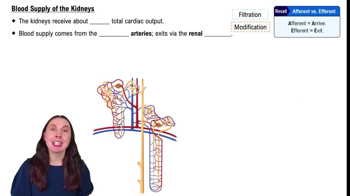
The kidneys filter blood to remove nitrogenous wastes and excess substances, producing urine. Blood entering the kidneys via the renal artery contains higher waste levels, while blood leaving through the renal vein has lower concentrations after filtration.
추천 영상:
6:37
Blood Supply to the Kidneys

Blood Vessels Involved in Waste Transport

The renal artery carries blood rich in nitrogenous wastes to the kidneys, while the renal vein carries filtered blood with reduced waste levels away. The hepatic vein and inferior vena cava transport blood from other regions and do not primarily reflect nitrogenous waste clearance.
추천 영상: