Ch. 4 Tissue: The Living Fabric
Marieb - Human Anatomy & Physiology 11th Edition
Marieb, Hoehn11th EditionHuman Anatomy & PhysiologyISBN: 9780136874034당신이 사용하는 게 아니라요?교과서 변경
4장, 문제 13

Matrix is extracellular. How does the matrix get to its characteristic position?

검증된 단계별 안내
1
Understand that the extracellular matrix (ECM) is produced and secreted by the cells that reside within a tissue, such as fibroblasts in connective tissue.
Recognize that the matrix components, including proteins like collagen, elastin, and glycoproteins, are synthesized inside the cell and then transported to the extracellular space via exocytosis.
Learn that once secreted, these matrix molecules self-assemble or organize in the extracellular space, guided by interactions with cell surface receptors and other matrix components.
Consider the role of cell adhesion molecules and integrins, which help anchor the matrix to the cell surface, ensuring the matrix is positioned correctly relative to the cells.
Appreciate that the dynamic remodeling of the matrix by enzymes such as matrix metalloproteinases also helps maintain the matrix's characteristic structure and position over time.

비슷한 문제에 대한 검증된 영상 답변:

이 영상 해법은 위 문제에 도움이 된다고 튜터들이 추천한 것입니다.
영상 길이:
1m
도움이 되었나요?

주요 개념

질문에 올바르게 답하기 위해 반드시 이해해야 하는 핵심 개념들은 다음과 같습니다.

Extracellular Matrix (ECM)

The extracellular matrix is a complex network of proteins and polysaccharides secreted by cells into the space outside the cell membrane. It provides structural support and biochemical signals to surrounding cells, influencing tissue development and function.
추천 영상:
3:31
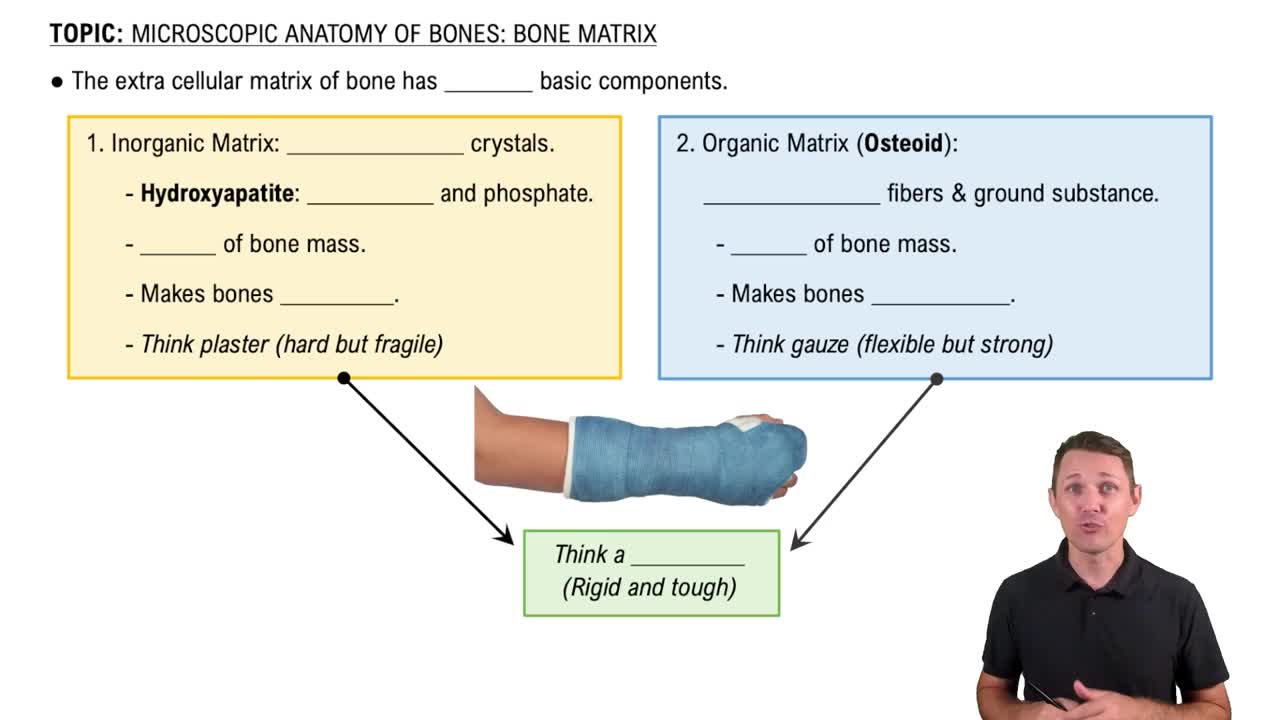
Bone Matrix

Secretion and Transport of Matrix Components

Cells synthesize matrix molecules internally and transport them via vesicles to the cell surface, where they are secreted into the extracellular space. This process ensures that matrix components reach their characteristic positions outside the cells.
추천 영상:
3:31
Bone Matrix

Matrix Assembly and Organization

Once secreted, matrix molecules self-assemble and interact with each other and cell surface receptors to form a structured and functional matrix. This organization determines the matrix’s characteristic position and mechanical properties in tissues.
추천 영상:
3:31
Bone Matrix