Ch. 7 The Skeleton
Marieb - Human Anatomy & Physiology 11th Edition
Marieb, Hoehn11th EditionHuman Anatomy & PhysiologyISBN: 9780136874034당신이 사용하는 게 아니라요?교과서 변경
7장, 문제 15

List at least two specific anatomical characteristics each for typical cervical, thoracic, and lumbar vertebrae that would allow anyone to identify each type correctly.

검증된 단계별 안내
1
Step 1: Identify two key anatomical features of typical cervical vertebrae. For example, note that cervical vertebrae usually have transverse foramina (holes in the transverse processes) and a bifid (split) spinous process, which are unique to this region.
Step 2: Identify two key anatomical features of typical thoracic vertebrae. For instance, thoracic vertebrae have facets on the sides of their bodies for rib articulation (costal facets) and long, downward-pointing spinous processes.
Step 3: Identify two key anatomical features of typical lumbar vertebrae. Lumbar vertebrae are characterized by their large, thick bodies to support more weight and short, broad spinous processes that project horizontally.
Step 4: Summarize the distinguishing features for each vertebral type to help with identification: cervical vertebrae with transverse foramina and bifid spinous processes; thoracic vertebrae with costal facets and long spinous processes; lumbar vertebrae with large bodies and broad spinous processes.
Step 5: Use these anatomical characteristics as a checklist when examining vertebrae to correctly classify them as cervical, thoracic, or lumbar.

비슷한 문제에 대한 검증된 영상 답변:

이 영상 해법은 위 문제에 도움이 된다고 튜터들이 추천한 것입니다.
영상 길이:
3m
도움이 되었나요?

주요 개념

질문에 올바르게 답하기 위해 반드시 이해해야 하는 핵심 개념들은 다음과 같습니다.

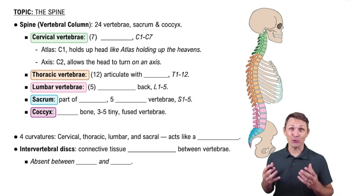
Anatomical Features of Cervical Vertebrae

Cervical vertebrae are characterized by small bodies and the presence of transverse foramina, which allow passage of the vertebral arteries. Additionally, their spinous processes are often bifid (split into two parts), distinguishing them from other vertebrae.
추천 영상:
가이드 코스
6:29
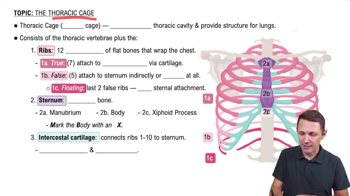
Spine (Vertebral Column)

Anatomical Features of Thoracic Vertebrae

Thoracic vertebrae have larger bodies than cervical vertebrae and possess facets on the sides of their bodies for rib articulation. Their spinous processes are long, pointed, and angled downward, which helps differentiate them from cervical and lumbar vertebrae.
추천 영상:

Anatomical Features of Lumbar Vertebrae

Lumbar vertebrae have the largest, thickest bodies to support more weight and lack transverse foramina and rib facets. Their spinous processes are short, broad, and project horizontally, making them distinct from cervical and thoracic vertebrae.
추천 영상:
가이드 코스
6:29
Spine (Vertebral Column)
관련 실천
교과서 질문

Mrs. Shea came up with what she considered to be a clever idea to bypass the long lines at Disney World. She had her husband rent a wheelchair and he wheeled her around from one exhibit to another for the better part of three days. As they sat on the plane, waiting to take off for Chicago, she complained to him that she had two sore spots on her buttocks. Why? What do you suppose would happen (to her buttocks) if she was wheeled around for a few more days?

1067
views
교과서 질문

Distinguish between the anulus fibrosus and nucleus pulposus regions of a disc. Which provides durability and strength? Which provides resilience? Which part is involved in a 'slipped' disc?

1115
views
교과서 질문

Mr. Wright had polio as a boy and was partially paralyzed in one lower limb for over a year. Although no longer paralyzed, he now has a severe lateral curvature of the lumbar spine. Explain what has happened and identify his condition.

1065
views
교과서 질문

Justiniano worked in a poultry-packing plant where his job was cutting open chickens and stripping out their visceral organs. After work, he typed for long hours on his computer keyboard, writing a book about his work in the plant. Soon, his wrist and hand began to hurt whenever he flexed it, and he began to awaken at night with pain and tingling on the thumb half of his hand. What condition did he probably have?

863
views
1
rank
교과서 질문

Name the cranial and facial bones and compare and contrast the functions of the cranial and facial skeletons.

1844
views
1
rank