Ch. 7 The Skeleton
Marieb - Human Anatomy & Physiology 11th Edition
Marieb, Hoehn11th EditionHuman Anatomy & PhysiologyISBN: 9780136874034당신이 사용하는 게 아니라요?교과서 변경
7장, 문제 6

Which ribs are floating ribs and why are they called that?

검증된 단계별 안내
1
Identify the total number of ribs in the human rib cage, which is 12 pairs, and understand their general classification into true ribs, false ribs, and floating ribs.
Recognize that floating ribs are specifically the 11th and 12th pairs of ribs in the rib cage.
Understand that floating ribs are called 'floating' because they do not attach to the sternum or to other ribs via cartilage, unlike true and false ribs.
Note that floating ribs are only attached to the vertebrae at the back and have free anterior ends, which is why they appear to 'float' without anterior connection.
Summarize that the floating ribs provide protection to the kidneys and other posterior organs but have more mobility due to their lack of anterior attachment.

비슷한 문제에 대한 검증된 영상 답변:

이 영상 해법은 위 문제에 도움이 된다고 튜터들이 추천한 것입니다.
영상 길이:
1m
도움이 되었나요?

주요 개념

질문에 올바르게 답하기 위해 반드시 이해해야 하는 핵심 개념들은 다음과 같습니다.

Floating Ribs

Floating ribs are the last two pairs of ribs (11th and 12th) in the rib cage that do not attach to the sternum or to other ribs in the front of the body. They are shorter and only connected to the vertebrae at the back.
추천 영상:
가이드 코스
2:45
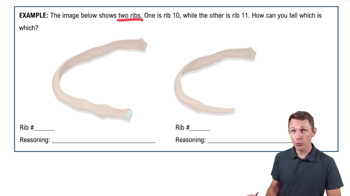
The Thoracic Cage Example 1

Anatomical Attachment of Ribs

Ribs typically connect to the thoracic vertebrae at the back and to the sternum at the front via costal cartilage. Floating ribs lack this anterior attachment, which distinguishes them from true and false ribs.
추천 영상:
가이드 코스
02:33
Anatomical Sections

Reason for the Term 'Floating'

They are called 'floating' ribs because their anterior ends are free and do not connect to the sternum or other ribs, giving the appearance that they 'float' without a front anchor.
추천 영상:
가이드 코스
03:00
Introduction to Directional Terms