Ch. 8 Joints
Marieb - Human Anatomy & Physiology 11th Edition
Marieb, Hoehn11th EditionHuman Anatomy & PhysiologyISBN: 9780136874034당신이 사용하는 게 아니라요?교과서 변경
8장, 문제 1

Match the key terms to the appropriate descriptions.
Key:
a. fibrous joints
b. cartilaginous joints
c. synovial joints 
_____    (1) exhibit a joint cavity 
_____    (2) types are sutures and syndesmoses 
_____    (3) bones connected by collagen fibers 
_____    (4) types include synchondroses and symphyses 
_____    (5) all are diarthrotic 
_____    (6) many are amphiarthrotic 
_____    (7) bones connected by a disc of hyaline cartilage or fibrocartilage 
_____    (8) nearly all are synarthrotic 
_____    (9) shoulder, hip, jaw, and elbow joints

검증된 단계별 안내
1
Step 1: Understand the three types of joints given: fibrous joints (a), cartilaginous joints (b), and synovial joints (c). Each has distinct structural and functional characteristics.
Step 2: Identify which joint type exhibits a joint cavity. Recall that synovial joints are characterized by the presence of a fluid-filled joint cavity, so for (1) the answer is synovial joints (c).
Step 3: Recognize that fibrous joints are connected by collagen fibers and include types such as sutures and syndesmoses. Therefore, for (2) and (3), the answers are fibrous joints (a).
Step 4: Know that cartilaginous joints are connected by cartilage (hyaline or fibrocartilage) and include synchondroses and symphyses. So, for (4) and (7), the answer is cartilaginous joints (b).
Step 5: Understand the functional classifications: synovial joints are all diarthrotic (freely movable) (5), many cartilaginous joints are amphiarthrotic (slightly movable) (6), and fibrous joints are mostly synarthrotic (immovable) (8). Finally, for (9), identify common synovial joints such as shoulder, hip, jaw, and elbow, so the answer is synovial joints (c).

비슷한 문제에 대한 검증된 영상 답변:

이 영상 해법은 위 문제에 도움이 된다고 튜터들이 추천한 것입니다.
영상 길이:
2m
도움이 되었나요?

주요 개념

질문에 올바르게 답하기 위해 반드시 이해해야 하는 핵심 개념들은 다음과 같습니다.

Fibrous Joints

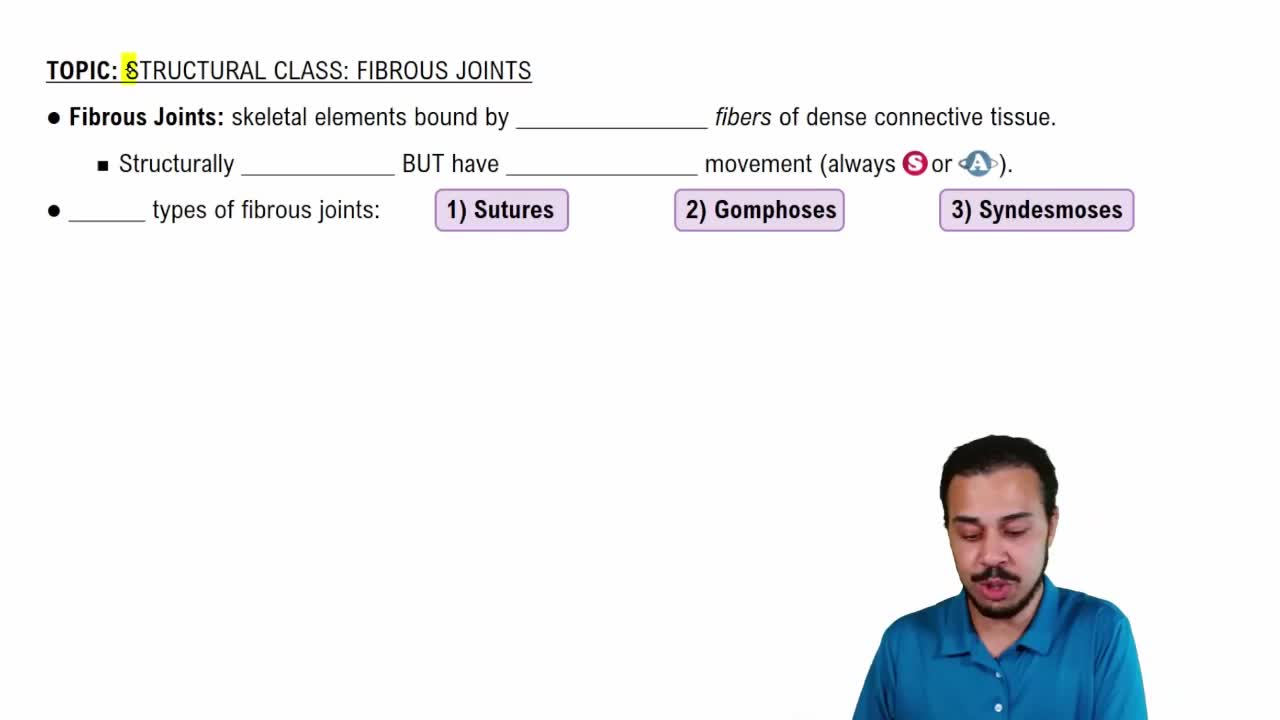
Fibrous joints are connections between bones held together by dense collagen fibers. They typically lack a joint cavity and are mostly immovable (synarthrotic) or slightly movable (amphiarthrotic). Common types include sutures found in the skull and syndesmoses like the connection between the tibia and fibula.
추천 영상:
가이드 코스
02:41
Introduction to Fibrous Joints

Cartilaginous Joints

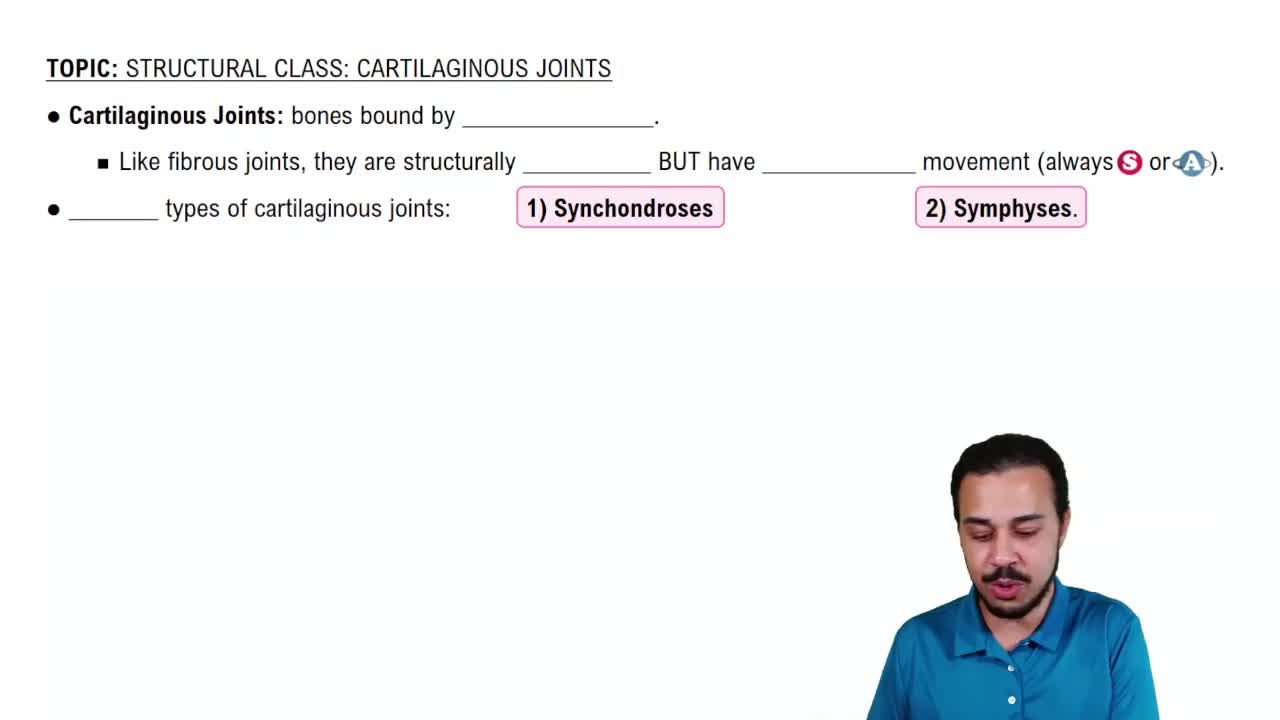
Cartilaginous joints connect bones using cartilage, either hyaline or fibrocartilage, without a joint cavity. They allow limited movement (amphiarthrotic) and include synchondroses, where bones are joined by hyaline cartilage, and symphyses, where fibrocartilage forms a disc between bones.
추천 영상:
가이드 코스
02:17
Introduction to Cartilaginous Joints

Synovial Joints

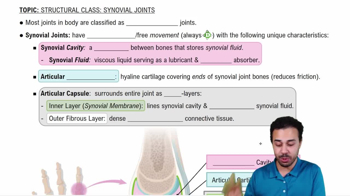
Synovial joints feature a fluid-filled joint cavity that permits free movement (diarthrotic). They are the most common and movable joints in the body, including the shoulder, hip, jaw, and elbow. These joints have structures like articular cartilage, synovial fluid, and a joint capsule to facilitate smooth motion.
추천 영상:
가이드 코스
8:20
Synovial Joints