Ch. 9 Muscles and Muscle Tissue
Marieb - Human Anatomy & Physiology 11th Edition
Marieb, Hoehn11th EditionHuman Anatomy & PhysiologyISBN: 9780136874034당신이 사용하는 게 아니라요?교과서 변경
9장, 문제 18

Explain what is meant by the term excitation-contraction coupling.

검증된 단계별 안내
1
Begin by defining excitation-contraction coupling as the physiological process that links the electrical signal (excitation) in a muscle fiber to the mechanical response (contraction) of the muscle.
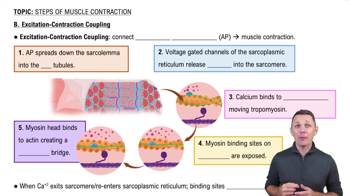
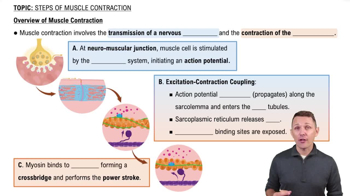
Explain that excitation starts with an action potential traveling along the sarcolemma (muscle cell membrane) and down the T-tubules, which are invaginations of the sarcolemma that penetrate into the muscle fiber.
Describe how the action potential triggers the release of calcium ions (Ca^{2+}) from the sarcoplasmic reticulum, a specialized organelle that stores calcium within the muscle cell.
Clarify that the increase in intracellular calcium concentration allows calcium to bind to troponin, causing a conformational change that moves tropomyosin away from the myosin-binding sites on actin filaments.
Conclude by stating that this exposure of binding sites enables cross-bridge cycling between actin and myosin, leading to muscle contraction.

비슷한 문제에 대한 검증된 영상 답변:

이 영상 해법은 위 문제에 도움이 된다고 튜터들이 추천한 것입니다.
영상 길이:
1m
도움이 되었나요?

주요 개념

질문에 올바르게 답하기 위해 반드시 이해해야 하는 핵심 개념들은 다음과 같습니다.

Excitation

Excitation refers to the process by which a muscle fiber receives a signal, typically an action potential, from a motor neuron. This electrical signal triggers events at the neuromuscular junction, leading to the depolarization of the muscle cell membrane.
추천 영상:
5:47
B. Excitation-Contraction Coupling

Contraction

Contraction is the process where muscle fibers generate tension and shorten in response to stimulation. This occurs through the sliding filament mechanism, where actin and myosin filaments interact to produce force.
추천 영상:
4:53
Overview of Muscle Contraction

Coupling Mechanism

The coupling mechanism links excitation to contraction by translating the electrical signal into a mechanical response. It involves calcium release from the sarcoplasmic reticulum, which initiates the interaction of contractile proteins, enabling muscle contraction.
추천 영상:
가이드 코스
04:57
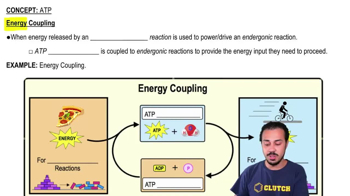
Energy Coupling