Ch. 13 The Peripheral Nervous System and Reflex Activity
Marieb - Human Anatomy & Physiology 7th Edition
Marieb, Hoehn7th EditionHuman Anatomy & PhysiologyISBN: 9780805359091당신이 사용하는 게 아니라요?교과서 변경
13장, 문제 32

Since there are only three types of cones, how can you explain the fact that we see many more colors?

검증된 단계별 안내
1
Step 1: Understand that the human eye contains three types of cone cells, each sensitive to different ranges of wavelengths corresponding roughly to short (S), medium (M), and long (L) wavelengths, often associated with blue, green, and red light respectively.
Step 2: Recognize that color perception arises from the brain interpreting the relative levels of stimulation from these three types of cones rather than from a one-to-one mapping of cones to colors.
Step 3: Learn that each cone type responds to a broad range of wavelengths with overlapping sensitivity curves, meaning that a single wavelength can stimulate multiple cone types to varying degrees.
Step 4: Realize that the brain compares the pattern of activation across the three cone types to distinguish a wide spectrum of colors, effectively creating a color space from combinations of cone responses.
Step 5: Conclude that this trichromatic system, combined with neural processing, allows us to perceive millions of colors even though only three types of cones are present.

비슷한 문제에 대한 검증된 영상 답변:

이 영상 해법은 위 문제에 도움이 된다고 튜터들이 추천한 것입니다.
영상 길이:
1m
도움이 되었나요?

주요 개념

질문에 올바르게 답하기 위해 반드시 이해해야 하는 핵심 개념들은 다음과 같습니다.

Trichromatic Theory of Color Vision

This theory states that the human eye has three types of cone cells, each sensitive to different wavelengths corresponding roughly to red, green, and blue light. These cones work together to detect a wide range of colors by varying their levels of activation.
추천 영상:
가이드 코스
07:29
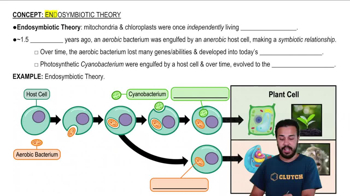
Endosymbiotic Theory

Color Mixing and Perception

Colors are perceived through the brain's interpretation of the combined signals from the three cone types. By mixing different intensities of red, green, and blue signals, the brain can create the perception of many distinct colors beyond just three.
추천 영상:
3:08
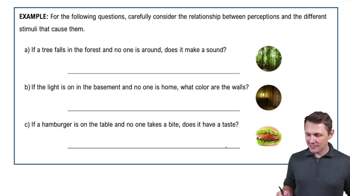
Introduction to Special Senses Example 1

Opponent Process Theory

This theory complements the trichromatic theory by explaining how the brain processes color signals in opposing pairs (red-green, blue-yellow, black-white). It helps explain color differentiation and afterimages, contributing to the perception of a broad color spectrum.
추천 영상:
가이드 코스
07:29
Endosymbiotic Theory