Ch. 2 The Chemical Level of Organization
Martini - Fundamentals of Anatomy & Physiology 11th Edition
Martini, Nath, Bartholomew11th EditionFundamentals of Anatomy & PhysiologyISBN: 9780136874089당신이 사용하는 게 아니라요?교과서 변경
2장, 문제 17

What four major classes of organic compounds (polymers) are found in the body?

검증된 단계별 안내
1
Understand that the question asks for the four major classes of organic compounds, also known as macromolecules or polymers, that are essential components of the human body.
Recall that these organic compounds are large molecules made up of smaller subunits called monomers, which join together to form polymers.
Identify the first major class: Carbohydrates, which are composed of sugar monomers and serve as a primary energy source.
Identify the second major class: Lipids, which include fats, oils, and steroids, and are important for energy storage, insulation, and cell membrane structure.
Identify the third and fourth major classes: Proteins, made of amino acid monomers and vital for structure, enzymes, and signaling; and Nucleic Acids, such as DNA and RNA, which store and transmit genetic information.

비슷한 문제에 대한 검증된 영상 답변:

이 영상 해법은 위 문제에 도움이 된다고 튜터들이 추천한 것입니다.
영상 길이:
2m

주요 개념

질문에 올바르게 답하기 위해 반드시 이해해야 하는 핵심 개념들은 다음과 같습니다.

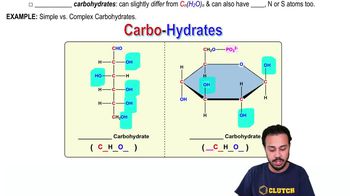
Carbohydrates

Carbohydrates are organic compounds made of carbon, hydrogen, and oxygen. They serve as a primary energy source and include sugars and starches. In the body, they exist as simple sugars or complex polymers like glycogen for energy storage.
추천 영상:

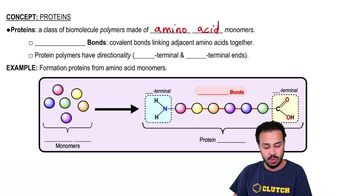
Proteins

Proteins are polymers of amino acids linked by peptide bonds. They perform diverse functions such as structural support, enzymes, and signaling. Their structure determines their specific role in bodily processes.
추천 영상:

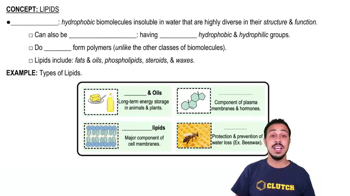
Lipids

Lipids are hydrophobic organic molecules including fats, oils, and steroids. They store energy, form cell membranes, and act as signaling molecules. Unlike other polymers, they are not formed by repeating monomers.
추천 영상: