Skip to main content
Beginning Algebra
나의 코스
배우기
시험 준비
AI 튜터
학습 가이드
플래시카드
앱을 사용해 보세요
나의 코스
배우기
시험 준비
AI 튜터
학습 가이드
플래시카드
앱을 사용해 보세요
뒤로
Multiplying and Dividing Complex Numbers definitions
카드를 뒤집기 위해 탭할 수 있습니다.
Complex Number
카드를 뒤집기 위해 탭할 수 있습니다.
👆
Complex Number
A value expressed as a sum of a real part and an imaginary part, typically written in the form a+bi.
진행 상황 추적
컨트롤 버튼이 '내비게이션' 모드로 변경되었습니다.
1/14
관련 플래시카드
관련 실천
추천 영상
Multiplying and Dividing Complex Numbers quiz
Multiplying and Dividing Complex Numbers
15 용어
Multiplying and Dividing Complex Numbers
10. Quadratic Equations
5 문제점
주제
ErnestBlazevic
Complex Solutions of Quadratic Equations
10. Quadratic Equations
5 문제점
주제
10. Quadratic Equations - Part 1 of 2
4 주제
12 문제점
장
ErnestBlazevic
10. Quadratic Equations - Part 2 of 2
3 주제
9 문제점
장
ErnestBlazevic
VideoThumbView.guidedCourse
05:10
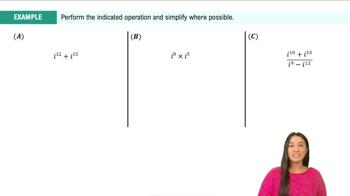
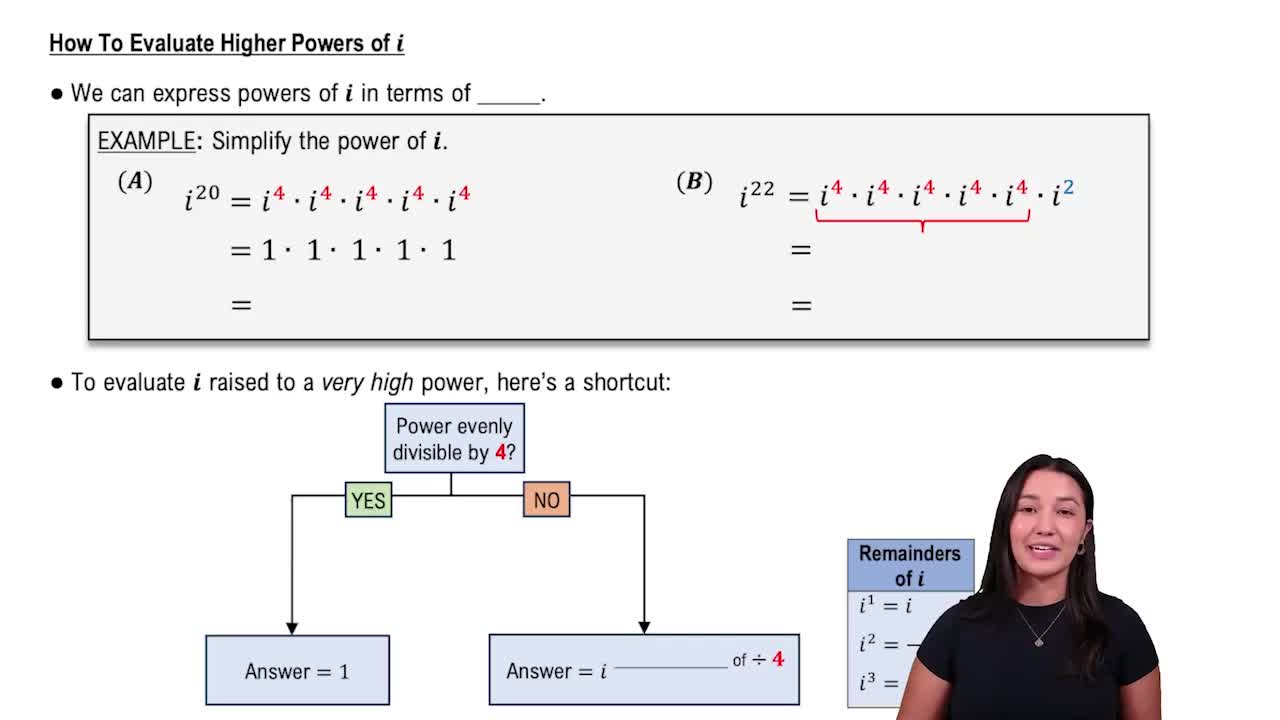
Higher Powers of i
47
views
1
rank
VideoThumbView.guidedCourse
04:10
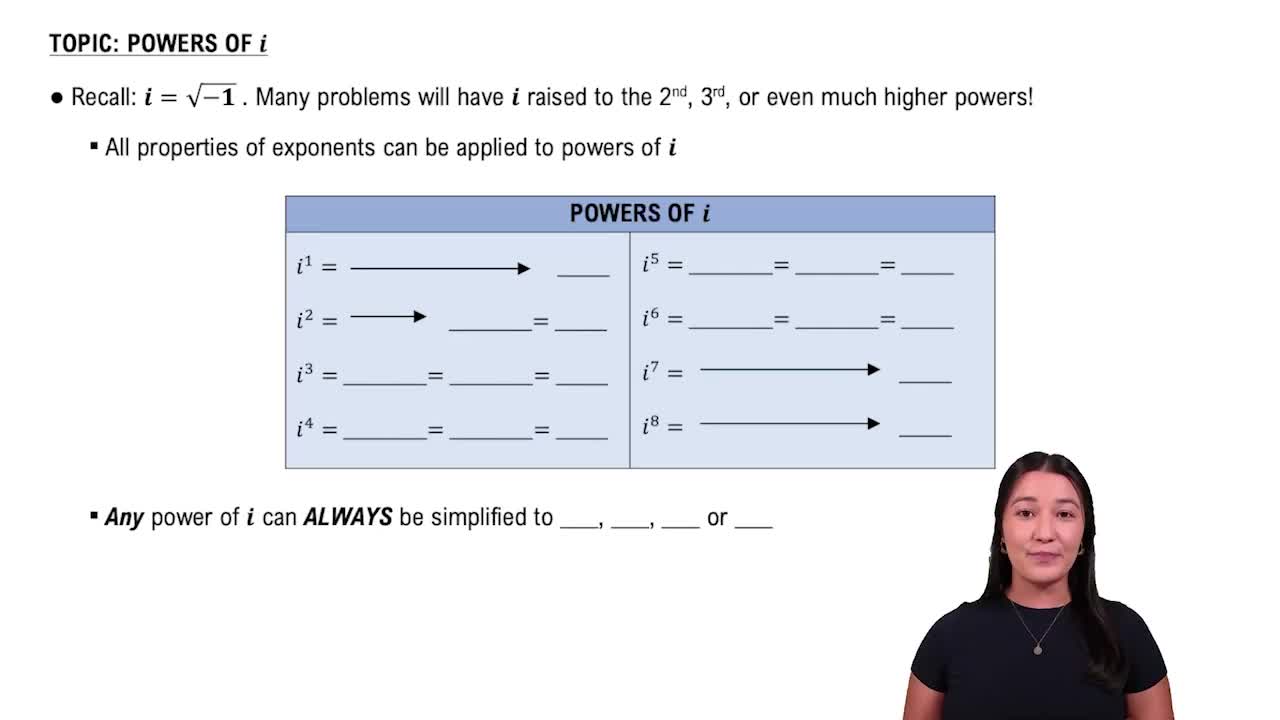
Powers of i
60
views
1
rank
VideoThumbView.guidedCourse
04:56
Higher Powers of i Example 1
39
views
1
rank
이 집합의 용어 (14)
하이드의 정의
Complex Number
A value expressed as a sum of a real part and an imaginary part, typically written in the form a+bi.
Imaginary Unit
A special symbol, denoted as i, representing the square root of negative one and forming the basis for imaginary numbers.
Standard Form
A way of writing a complex value as a sum of its real and imaginary parts, arranged as a+bi.
Complex Conjugate
A value formed by changing the sign of the imaginary part of a complex number, keeping the real part unchanged.
FOIL Method
A process for multiplying two binomials by multiplying First, Outside, Inside, and Last terms, then combining like terms.
Distribution
A multiplication technique where each term in one expression is multiplied by every term in another.
I Squared
A result equal to negative one, obtained when the imaginary unit is multiplied by itself.
Like Terms
Parts of an expression that have the same variable components and can be combined through addition or subtraction.
Denominator
The bottom part of a fraction, which in complex division often contains an imaginary term to be eliminated.
Numerator
The top part of a fraction, which is multiplied by the complex conjugate during division.
Real Part
The component of a complex value that does not involve the imaginary unit, represented by a in a+bi.
Imaginary Part
The component of a complex value that is multiplied by the imaginary unit, represented by b in a+bi.
Exponent
A number indicating how many times a value, such as the imaginary unit, is multiplied by itself.
Remainder
The amount left after dividing the exponent of i by 4, used to determine the simplified value of high powers of i.
 뒤로뒤로
뒤로뒤로
 05:10
05:10