Skip to main content
Beginning & Intermediate Algebra
나의 코스
배우기
시험 준비
AI 튜터
학습 가이드
플래시카드
탐험해 보세요
앱을 사용해 보세요
나의 코스
배우기
시험 준비
AI 튜터
학습 가이드
플래시카드
탐험해 보세요
앱을 사용해 보세요
뒤로
Direct & Inverse Variation definitions
카드를 뒤집기 위해 탭할 수 있습니다.
Direct Variation
카드를 뒤집기 위해 탭할 수 있습니다.
👆
Direct Variation
Relationship where two quantities change together, modeled by a linear equation with a constant multiplier.
진행 상황 추적
컨트롤 버튼이 '내비게이션' 모드로 변경되었습니다.
1/29
관련 플래시카드
관련 실천
추천 영상
Direct & Inverse Variation quiz
Direct & Inverse Variation
15 용어
Direct & Inverse Variation
10. Relations and Functions
5 문제점
주제
ErnestBlazevic
Composition of Functions
10. Relations and Functions
5 문제점
주제
David-PaigeMcFarlane
10. Relations and Functions - Part 1 of 2
4 주제
12 문제점
장
David-PaigeMcFarlane
10. Relations and Functions - Part 2 of 2
1 주제
3 문제점
장
AllySteele
04:31
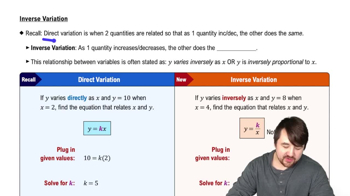
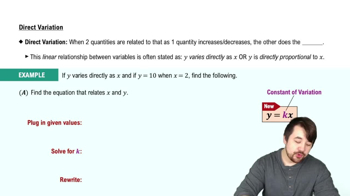
Direct Variation
61
views
05:33
Inverse Variation
61
views
03:07
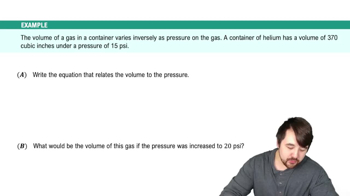
Inverse Variation Example 2
65
views
이 집합의 용어 (29)
하이드의 정의
Direct Variation
Relationship where two quantities change together, modeled by a linear equation with a constant multiplier.
Inverse Variation
Relationship where one quantity increases as the other decreases, represented by a constant divided by a variable.
Linear Equation
Mathematical expression showing a straight-line relationship between two variables.
Constant of Variation
Fixed value that links two variables in a variation equation, found by substituting known values.
Directly Proportional
Situation where two variables increase or decrease together in a fixed ratio.
Inversely Proportional
Situation where one variable increases as the other decreases, maintaining a constant product.
Variable
Symbol representing a quantity that can change within an equation or relationship.
Equation
Statement showing the equality of two mathematical expressions, often used to model relationships.
Restriction
Limitation placed on variable values, such as preventing division by zero in inverse variation.
Proportion
Comparison of two ratios or relationships, often used to describe variation.
Model
Mathematical representation of a real-world relationship between quantities.
Product
Result of multiplying two quantities, important in inverse variation relationships.
Ratio
Comparison of two quantities, central to understanding proportional relationships.
Substitution
Process of replacing variables with known values to solve for unknowns in equations.
Real World Application
Use of mathematical concepts to describe practical situations like price and quantity or speed and time.
Quantity
Amount or value represented by a variable in variation equations.
Relationship
Connection between two variables, defined by how one changes in response to the other.
Multiplier
Number by which a variable is multiplied in direct variation equations.
Division
Operation used in inverse variation equations to relate variables.
Opposite Effect
Phenomenon where one variable increases while the other decreases, characteristic of inverse variation.
Same Direction
Situation where both variables increase or decrease together, characteristic of direct variation.
Proportionality
Quality describing how variables relate in fixed ratios, either directly or inversely.
Instant
Specific moment or value used to determine the constant in variation equations.
Application Problem
Exercise involving real-life scenarios to practice variation concepts.
Solution
Final value or expression found after solving a variation equation.
Direction
Way in which variables change relative to each other in variation relationships.
Restriction on Domain
Rule limiting possible values for variables, such as excluding zero in inverse variation.
Practice
Repeated exercises to reinforce understanding of variation concepts.
Expansion
Extension of familiar concepts, such as linear equations, to new ideas like direct variation.
 뒤로뒤로
뒤로뒤로


 04:31
04:31