Describe the structure of an antibody and explain the roles of its variable and constant regions.
An antibody is a Y-shaped protein composed of four polypeptide chains: two identical light chains and two identical heavy chains, linked by disulfide bonds. Each chain has a variable (V) region at the tips of the Y, which binds specifically to antigens at their epitopes, and a constant (C) region, which forms the stem and is recognized by immune cells. The variable region determines antigen specificity, while the constant region mediates interactions with other components of the immune system.
 뒤로
뒤로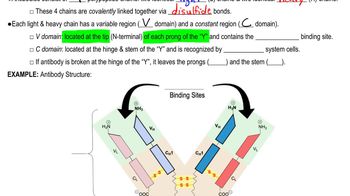
 05:40
05:40