Skip to main content
Biochemistry
나의 코스
배우기
시험 준비
AI 튜터
학습 가이드
플래시카드
탐험해 보세요
앱을 사용해 보세요
나의 코스
배우기
시험 준비
AI 튜터
학습 가이드
플래시카드
탐험해 보세요
앱을 사용해 보세요
뒤로
Physical Properties of Biological Membranes definitions
카드를 뒤집기 위해 탭할 수 있습니다.
Lipid Bilayer
카드를 뒤집기 위해 탭할 수 있습니다.
👆
Lipid Bilayer
Double-layered structure forming biological membranes, composed mainly of phospholipids, providing a barrier and matrix for diffusion.
진행 상황 추적
컨트롤 버튼이 '내비게이션' 모드로 변경되었습니다.
1/15
관련 플래시카드
관련 실천
추천 영상
Physical Properties of Biological Membranes quiz
Physical Properties of Biological Membranes
15 용어
Physical Properties of Biological Membranes
10. Lipids
7 문제점
주제
Types of Membrane Proteins
10. Lipids
7 문제점
주제
10. Lipids - Part 1 of 5
5 주제
14 문제점
장
10. Lipids - Part 2 of 5
5 주제
13 문제점
장
10. Lipids - Part 3 of 5
5 주제
13 문제점
장
10. Lipids - Part 4 of 5
5 주제
13 문제점
장
10. Lipids - Part 5 of 5
5 주제
13 문제점
장
VideoThumbView.guidedCourse
05:19
Physical Properties of Biological Membranes
811
views
6
rank
VideoThumbView.guidedCourse
03:49
Physical Properties of Biological Membranes
1039
views
12
rank
VideoThumbView.guidedCourse
04:44
Physical Properties of Biological Membranes
819
views
7
rank
1
comments
이 집합의 용어 (15)
하이드의 정의
Lipid Bilayer
Double-layered structure forming biological membranes, composed mainly of phospholipids, providing a barrier and matrix for diffusion.
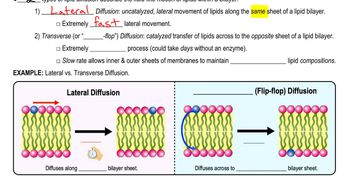
Lateral Diffusion
Rapid, uncatalyzed movement of lipids side-to-side within the same layer of a membrane, maintaining sheet composition.
Transverse Diffusion
Slow, enzyme-catalyzed transfer of lipids between membrane layers, also known as flip-flop, altering sheet composition.
Flippase
Membrane enzyme requiring ATP, moves specific lipids from the outer to the inner sheet, maintaining asymmetry.
Floppase
Membrane enzyme requiring ATP, transfers lipids from the inner to the outer sheet, contributing to membrane diversity.
Scramblase
Membrane enzyme facilitating bidirectional lipid movement down concentration gradients, does not require ATP.
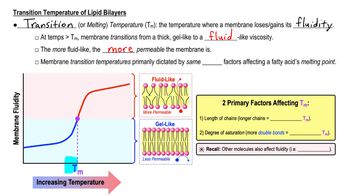
Transition Temperature
Specific point where membrane shifts from gel-like rigidity to fluidity, affecting permeability and viscosity.
Membrane Fluidity
Degree of flexibility and movement within a membrane, influenced by temperature, lipid composition, and embedded molecules.
Permeability
Ease with which substances cross a membrane, increases with fluidity and decreases in gel-like states.
Fatty Acid Chain Length
Number of carbon atoms in phospholipid tails; longer chains raise transition temperature and reduce fluidity.
Saturation
Extent of double bonds in fatty acid chains; more double bonds lower transition temperature and increase fluidity.
Phospholipid
Major membrane component with hydrophilic head and hydrophobic tails, forming the bilayer structure.
Cholesterol
Membrane-embedded molecule modulating fluidity and permeability, stabilizing membrane structure.
Gel-like State
Rigid, less permeable membrane condition occurring below transition temperature, restricting substance movement.
ATP
Energy molecule required by certain membrane enzymes to catalyze lipid movement between bilayer sheets.
 뒤로뒤로
뒤로뒤로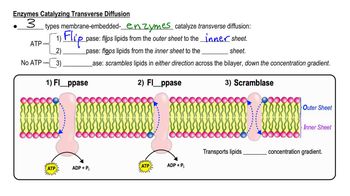
 05:19
05:19