Skip to main content
Biochemistry
나의 코스
배우기
시험 준비
AI 튜터
학습 가이드
플래시카드
탐험해 보세요
앱을 사용해 보세요
나의 코스
배우기
시험 준비
AI 튜터
학습 가이드
플래시카드
탐험해 보세요
앱을 사용해 보세요
뒤로
Reducing Sugars Tests quiz
카드를 뒤집기 위해 탭할 수 있습니다.
What is a reducing sugar?
카드를 뒤집기 위해 탭할 수 있습니다.
👆
What is a reducing sugar?
A reducing sugar is a sugar with a free aldehyde or ketone group capable of being oxidized, such as aldoses with a free aldehyde group.
진행 상황 추적
컨트롤 버튼이 '내비게이션' 모드로 변경되었습니다.
1/15
관련 플래시카드
관련 실천
추천 영상
Reducing Sugars Tests definitions
Reducing Sugars Tests
15 용어
Reducing Sugars Tests
9. Carbohydrates
7 문제점
주제
Glycosidic Bond
9. Carbohydrates
7 문제점
주제
9. Carbohydrates - Part 1 of 5
5 주제
14 문제점
장
9. Carbohydrates - Part 2 of 5
5 주제
13 문제점
장
9. Carbohydrates - Part 3 of 5
5 주제
13 문제점
장
9. Carbohydrates - Part 4 of 5
5 주제
13 문제점
장
9. Carbohydrates - Part 5 of 5
5 주제
13 문제점
장
VideoThumbView.guidedCourse
01:34
Reducing Sugar Tests
913
views
6
rank
VideoThumbView.guidedCourse
04:27
Reducing Sugar Tests
2137
views
4
rank
VideoThumbView.guidedCourse
02:57
Reducing Sugar Tests
829
views
6
rank
이 집합의 용어 (15)
하이드의 정의
What is a reducing sugar?
A reducing sugar is a sugar with a free aldehyde or ketone group capable of being oxidized, such as aldoses with a free aldehyde group.
What color change indicates a positive Fehling's test for reducing sugars?
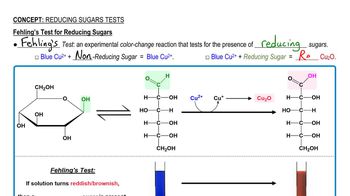
A positive Fehling's test is indicated by a color change from blue to red due to the formation of red cupric oxide precipitate.
What is the oxidizing agent used in Fehling's and Benedict's tests?
Both Fehling's and Benedict's tests use blue cupric ion (Cu²⁺) as the oxidizing agent.
What happens to the cupric ion in the presence of a reducing sugar during Fehling's test?
The cupric ion is reduced, forming a red cupric oxide (Cu₂O) precipitate.
How can you distinguish between reducing and non-reducing sugars using Fehling's test?
Reducing sugars cause the solution to turn red, while non-reducing sugars leave the solution blue with no precipitate.
What structural feature allows a sugar to be classified as reducing?
A sugar is reducing if it has a free aldehyde group or a hemiacetal that can revert to the linear form with a free aldehyde.
How is Benedict's test similar to Fehling's test?
Benedict's test is similar to Fehling's test in reaction mechanism and result, both showing a color change to indicate reducing sugars.
What is a practical advantage of Benedict's solution over Fehling's solution?
Benedict's solution has a longer shelf life, making it more commonly used in labs.
What is the main result of a positive Benedict's test?
A positive Benedict's test results in a color change from blue to red, indicating the presence of reducing sugars.
What oxidizing agent is used in Tollens' test?
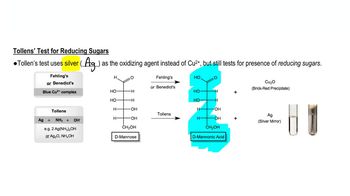
Tollens' test uses silver ions (Ag⁺) as the oxidizing agent.
What visual result indicates a positive Tollens' test?
A positive Tollens' test produces a silver mirror on the surface of the reaction vessel.
What happens to the reducing sugar during Tollens' test?
The reducing sugar is oxidized to a carboxylic acid, while silver ions are reduced to metallic silver.
How do Fehling's and Benedict's tests detect reducing sugars?
They detect reducing sugars by a color change resulting from the reduction of cupric ions to cupric oxide.
What is the negative control result in Fehling's or Benedict's test?
The solution remains blue with no red precipitate, indicating no reducing sugars are present.
Why are reducing sugars important in biochemistry analysis?
Reducing sugars are important because their ability to reduce metal ions is used to identify and analyze carbohydrates.
 뒤로뒤로
뒤로뒤로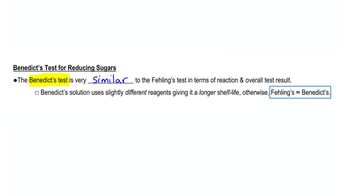
 01:34
01:34