Skip to main content
Biochemistry
나의 코스
배우기
시험 준비
AI 튜터
학습 가이드
플래시카드
탐험해 보세요
앱을 사용해 보세요
나의 코스
배우기
시험 준비
AI 튜터
학습 가이드
플래시카드
탐험해 보세요
앱을 사용해 보세요
뒤로
Types of Membrane Proteins definitions
카드를 뒤집기 위해 탭할 수 있습니다.
Integral Protein
카드를 뒤집기 위해 탭할 수 있습니다.
👆
Integral Protein
Non-covalently embedded structure spanning the entire phospholipid bilayer, possessing both extracellular and intracellular regions.
진행 상황 추적
컨트롤 버튼이 '내비게이션' 모드로 변경되었습니다.
1/15
관련 플래시카드
관련 실천
추천 영상
Types of Membrane Proteins quiz #1
Types of Membrane Proteins
10 용어
Types of Membrane Proteins
10. Lipids
7 문제점
주제
Integral Membrane Proteins
10. Lipids
7 문제점
주제
10. Lipids - Part 1 of 5
5 주제
14 문제점
장
10. Lipids - Part 2 of 5
5 주제
13 문제점
장
10. Lipids - Part 3 of 5
5 주제
13 문제점
장
10. Lipids - Part 4 of 5
5 주제
13 문제점
장
10. Lipids - Part 5 of 5
5 주제
13 문제점
장
VideoThumbView.guidedCourse
03:23
Types of Membrane Proteins
3584
views
40
rank
VideoThumbView.guidedCourse
03:35
Types of Membrane Proteins
2801
views
54
rank
이 집합의 용어 (15)
하이드의 정의
Integral Protein
Non-covalently embedded structure spanning the entire phospholipid bilayer, possessing both extracellular and intracellular regions.
Peripheral Protein
Structure located on the membrane surface, not spanning the bilayer, often interacting with other membrane components.
Lipid Bilayer
Double-layered membrane matrix composed of phospholipids, providing a barrier and environment for protein integration.
Lipid-Linked Protein
Peripheral structure covalently attached to lipid groups within the bilayer, forming a distinct membrane association.
Lipoprotein
Protein covalently bonded to a lipid, often found on the membrane periphery, contributing to structural and functional diversity.
Extracellular Matrix
Network outside the cell to which membrane proteins anchor, supporting cellular structure and communication.
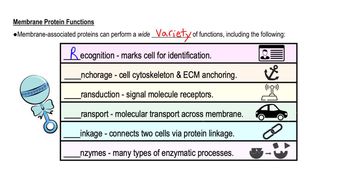
Recognition
Function enabling cell identification, allowing immune cells to distinguish healthy from foreign cells.
Anchorage
Function facilitating attachment of the cell or cytoskeleton to external structures, maintaining cellular stability.
Signal Transduction
Process where membrane proteins relay signals between the cell's exterior and interior, enabling communication.
Transport
Function allowing movement of molecules across the membrane, supporting cellular import and export.
Linkage
Function connecting cells via protein interactions, promoting tissue integrity and cellular cooperation.
Enzymatic Activity
Role in catalyzing chemical reactions at the membrane, accelerating diverse biochemical processes.
Facilitated Diffusion
Mechanism where membrane proteins assist passive movement of molecules across the bilayer.
Cell Identification
Capability of membrane proteins to mark cells, crucial for immune recognition and tissue organization.
Structural Integrity
Contribution of membrane proteins to maintaining cell shape and resilience against external forces.
 뒤로뒤로
뒤로뒤로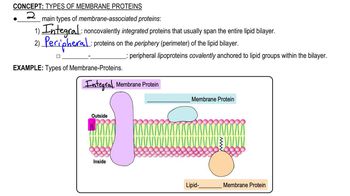
 03:23
03:23