뒤로

Biochemistry 9

컨트롤 버튼이 '내비게이션' 모드로 변경되었습니다.
1/20
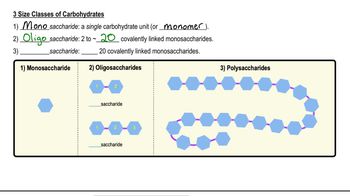
  • Define monosaccharide, disaccharide, oligosaccharide, polysaccharide

    Monosaccharide: simple sugars with 3-9 carbons.
    Disaccharide: 2 linked monosaccharides.
    Oligosaccharide: several linked monosaccharides.
    Polysaccharide: polymer of many saccharide units.
  • Difference between aldoses and ketoses

    Aldoses have an aldehyde group; ketoses have a ketone group.
  • What are D- and L- sugars?

    Stereoisomers differing in configuration at the asymmetric carbon farthest from the carbonyl; D has −OH on right, L on left in Fischer projection.
  • What are anomers and how are they formed?

    Isomers differing at the anomeric carbon formed by cyclization creating a new chiral center; designated as α or β.
  • Explain mutarotation

    The process of interconversion between α and β anomers in solution.
  • Difference between furanose and pyranose rings

    Furanose: five-membered ring formed by C4–OH reacting with C1.
    Pyranose: six-membered ring formed by C5–OH reacting with C1.
  • Identify the reducing end of saccharides

    The end with a free anomeric carbon capable of opening to an aldehyde or ketone, allowing reduction.
  • What is Fehling’s reaction used for?

    A test using alkaline Cu2+ to detect reducing sugars by forming a red precipitate.
  • Structure and function of sucrose, lactose, and maltose

    Sucrose: glucose + fructose, non-reducing.
    Lactose: glucose + galactose, reducing sugar.
    Maltose: two glucose units, reducing sugar.
  • Compare starch, glycogen, and cellulose

    Starch: plant energy storage, mix of amylose and amylopectin.
    Glycogen: animal energy storage, highly branched.
    Cellulose: plant structural polysaccharide, β(1→4) linked glucose.
  • Difference between amylose, amylopectin, and glycogen

    Amylose: unbranched α(1→4) glucose polymer.
    Amylopectin: branched α(1→4) with α(1→6) branches.
    Glycogen: similar to amylopectin but more frequent and shorter branches.
  • What are N-linked and O-linked glycans?

    N-linked: attached to asparagine amide side chain.
    O-linked: attached to serine or threonine hydroxyl side chains.
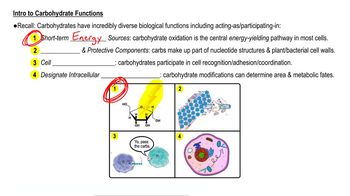
  • Role of carbohydrates in biological systems

    Energy metabolism and storage, molecular recognition, cellular protection, adhesion, lubrication, and structural maintenance.
  • What are glycosaminoglycans?

    Polysaccharides with repeating disaccharide units, often sulfated, functioning as lubricants and structural components.
  • Describe peptidoglycan structure and function

    Bacterial cell wall polymer of alternating N-acetylglucosamine and N-acetylmuramic acid crosslinked by peptides.
  • How does penicillin affect peptidoglycan synthesis?

    Inhibits crosslinking enzymes, weakening bacterial cell walls.
  • What is the significance of glycoproteins?

    Proteins covalently linked to oligosaccharides; involved in protein distribution, cell adhesion, and recognition.
  • Explain the ABO blood group antigens

    Carbohydrate antigens on red blood cells; A has GalNAc transferase, B has Gal transferase, AB has both, O has neither.
  • What is erythropoietin (EPO) and its glycosylation role?

    Hormone stimulating red blood cell production; glycosylation stabilizes EPO and prolongs its half-life.
  • How does influenza virus neuraminidase function and its inhibition?

    Cleaves sialic acid from host cells to release new virions; inhibited by Tamiflu, a sialic acid analog.