Skip to main content
General Biology
나의 코스
배우기
시험 준비
AI 튜터
학습 가이드
교과서적 해결책
플래시카드
탐험해 보세요
앱을 사용해 보세요
나의 코스
배우기
시험 준비
AI 튜터
학습 가이드
교과서적 해결책
플래시카드
탐험해 보세요
앱을 사용해 보세요
뒤로
Adaptive Immunity exam
1 학생이 이 점이 도움이 되었다고 느꼈습니다
카드를 뒤집기 위해 탭할 수 있습니다.
Adaptive Immune System
카드를 뒤집기 위해 탭할 수 있습니다.
👆
Adaptive Immune System
A part of the immune system that mounts specific defenses against pathogens through antigen recognition.
진행 상황 추적
컨트롤 버튼이 '내비게이션' 모드로 변경되었습니다.
1/29
관련 플래시카드
관련 실천
추천 영상
Adaptive Immunity quiz #1
Adaptive Immunity
29 용어
Adaptive Immunity definitions
Adaptive Immunity
13 용어
Adaptive Immunity quiz #1
Adaptive Immunity
10 용어
Adaptive Immunity
41. Immune System
7 문제점
주제
Jason
Innate Immunity
41. Immune System
4 문제점
주제
Jason
41. Immune System
3 주제
5 문제점
장
Jason
04:06
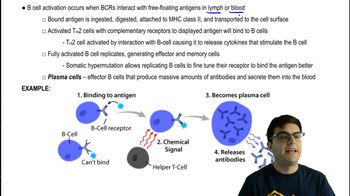
Helper T Cells and B Cells
3840
views
10
rank
04:23
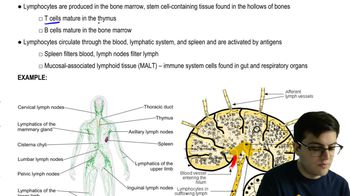
Lymphocytes
3013
views
21
rank
07:51
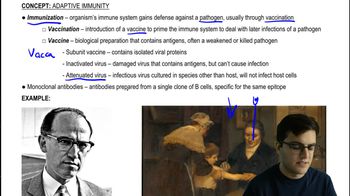
Immunization and Autoimmunity
2393
views
10
rank
이 집합의 용어 (29)
하이드의 정의
Adaptive Immune System
A part of the immune system that mounts specific defenses against pathogens through antigen recognition.
B Cells
Lymphocytes that produce antibodies to bind antigens.
T Cells
Lymphocytes that require antigen presentation via MHC proteins to become activated.
Antigen
A molecule that produces an immune response, often having multiple epitopes.
Antibodies
Y-shaped proteins produced by B cells that bind to antigens.
Major Histocompatibility Complex (MHC)
Proteins that present antigens on the cell surface for T cell recognition.
Clonal Expansion
The process by which activated B and T cells divide to form effector and memory cells.
Effector Cells
Short-lived cells that take immediate action against pathogens.
Memory Cells
Long-lived cells that remain in the body to respond quickly to future infections.
Primary Immune Response
The initial response of the adaptive immune system to a new pathogen.
Secondary Immune Response
A faster and stronger immune response upon re-exposure to a previously encountered pathogen.
Vaccination
The introduction of a vaccine to prime the immune system against future infections.
Helper T Cells
Effector T cells that assist in activating other immune cells by secreting cytokines.
Cytotoxic T Cells
Effector T cells that kill pathogen-infected cells.
Opsonization
The process by which antibodies enhance the phagocytosis of pathogens.
Agglutination
The clumping of pathogens due to antibodies binding multiple antigens.
Passive Immunity
Immunity acquired by receiving antibodies from another individual.
Active Immunity
Immunity developed through the production of antibodies in response to an infection or vaccination.
Self-Nonself Recognition
The ability of the immune system to distinguish between the body's own cells and foreign cells.
Antigen Presentation
The display of antigens on the cell surface by MHC proteins for T cell recognition.
CD4+ T Cells
T cells that interact with MHC class II proteins and become helper T cells.
CD8+ T Cells
T cells that interact with MHC class I proteins and become cytotoxic T cells.
Plasma Cells
Effector B cells that produce and secrete large amounts of antibodies.
Somatic Hypermutation
A process that allows B cells to fine-tune their antigen receptors for better binding.
HIV
A virus that infects and kills CD4+ T cells, leading to a weakened immune system.
AIDS
A condition resulting from HIV infection characterized by a severely weakened immune system.
Allergies
Abnormal immune responses to non-threatening antigens, known as allergens.
Autoimmunity
An immune response directed against the body's own cells and molecules.
Mucosal Associated Lymphoid Tissue (MALT)
Immune system cells found in the gut and respiratory tract that capture invading pathogens.
 뒤로뒤로
뒤로뒤로
 04:06
04:06