Skip to main content
General Biology
나의 코스
배우기
시험 준비
AI 튜터
학습 가이드
교과서적 해결책
플래시카드
탐험해 보세요
앱을 사용해 보세요
나의 코스
배우기
시험 준비
AI 튜터
학습 가이드
교과서적 해결책
플래시카드
탐험해 보세요
앱을 사용해 보세요
뒤로
Animal Tissues exam
1 학생이 이 점이 도움이 되었다고 느꼈습니다
카드를 뒤집기 위해 탭할 수 있습니다.
Anatomy
카드를 뒤집기 위해 탭할 수 있습니다.
👆
Anatomy
The study of an organism's physical structures.
진행 상황 추적
컨트롤 버튼이 '내비게이션' 모드로 변경되었습니다.
1/29
관련 플래시카드
관련 실천
추천 영상
Animal Tissues quiz #1
Animal Tissues
27 용어
Animal Tissues definitions
Animal Tissues
12 용어
Animal Tissues quiz #1
Animal Tissues
10 용어
Animal Tissues
38. Animal Form and Function
5 문제점
주제
Jason
Metabolism and Homeostasis
38. Animal Form and Function
7 문제점
주제
Jason
38. Animal Form and Function
3 주제
8 문제점
장
Jason
03:16
Muscle and Epithelial Tissues
3673
views
35
rank
1
comments
05:37
Tissues and Organs
3700
views
38
rank
10:26
Animal Physiology and Fitness Trade-Offs
4438
views
59
rank
1
comments
이 집합의 용어 (29)
하이드의 정의
Anatomy
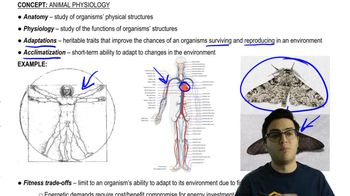
The study of an organism's physical structures.
Physiology
The study of the functions of an organism's structures.
What is an adaptation?
A heritable trait that improves an organism's chances of surviving and reproducing.
Acclimatization
Short-term adjustments to changes in the environment.
Fitness trade-offs
Limits to perfect adaptations due to finite energy resources.
What are germ layers?
Embryonic tissues that develop into specialized tissues and organs.
Ectoderm
The outer germ layer that develops into nervous tissue and skin.
Mesoderm
The middle germ layer that develops into muscle and connective tissues.
Endoderm
The innermost germ layer that develops into the lining of the digestive and respiratory systems.
What is connective tissue?
Tissue that supports, connects, or separates different types of tissues and organs.
Loose connective tissue
The most common type of connective tissue, holding organs in place and attaching epithelial tissue.
Dense connective tissue
Tissue dense with collagen fibers, making up tendons and ligaments.
Supportive connective tissue
Includes bone and cartilage, providing structural integrity.
Fluid connective tissue
Blood, which has a liquid extracellular matrix called plasma.
What is nervous tissue?
Tissue that conducts electrical and chemical signals.
Neuron
A cell that receives and transmits electrical signals in the nervous system.
Glia
Support cells for neurons, essential for their survival and function.
What is muscle tissue?
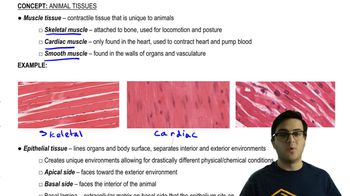
Tissue capable of contraction, enabling movement.
Skeletal muscle
Muscle attached to bones, used for locomotion and posture.
Cardiac muscle
Muscle found only in the heart, responsible for pumping blood.
Smooth muscle
Muscle found in the walls of organs and blood vessels, allowing them to contract.
What is epithelial tissue?
Tissue that lines organs and body surfaces, separating interior and exterior environments.
Apical side
The side of epithelial tissue that faces away from the interior of the body.
Basal side
The side of epithelial tissue that faces the interior of the body or organ.
Basal lamina
A special type of extracellular matrix on the basal side of epithelial tissue.
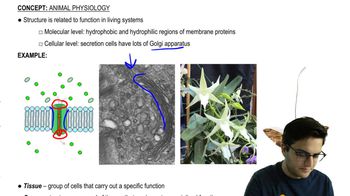
What is the function of the Golgi apparatus?
An organelle involved in the secretion and transport of molecules.
What is the role of the respiratory system?
A group of organs working together to perform gas exchange and breathing.
Extracellular matrix
An array of proteins and ground substance that provides structural support outside of cells.
Adipose tissue
A type of loose connective tissue made up of fat cells.
 뒤로뒤로
뒤로뒤로
 03:16
03:16