Skip to main content
General Biology
나의 코스
배우기
시험 준비
AI 튜터
학습 가이드
교과서적 해결책
플래시카드
탐험해 보세요
앱을 사용해 보세요
나의 코스
배우기
시험 준비
AI 튜터
학습 가이드
교과서적 해결책
플래시카드
탐험해 보세요
앱을 사용해 보세요
뒤로
ATP quiz #6
카드를 뒤집기 위해 탭할 수 있습니다.
How does ATP provide energy for cellular activities?
카드를 뒤집기 위해 탭할 수 있습니다.
👆
How does ATP provide energy for cellular activities?
ATP provides energy through hydrolysis, where a phosphate group is removed, releasing energy that can be used by the cell.
진행 상황 추적
컨트롤 버튼이 '내비게이션' 모드로 변경되었습니다.
1/27
관련 플래시카드
관련 실천
추천 영상
ATP definitions
ATP
6 용어
ATP quiz #1
ATP
22 용어
ATP exam
ATP
29 용어
ATP
7. Energy and Metabolism
3 문제점
주제
Jason
Enzymes
7. Energy and Metabolism
6 문제점
주제
Jason
7. Energy and Metabolism
10 주제
13 문제점
장
Brendan
04:57
Energy Coupling
18639
views
230
rank
1
comments
06:43
ATP
23757
views
363
rank
3
comments
03:
Phosphorylation
17082
views
369
rank
이 집합의 용어 (27)
하이드의 정의
How does ATP provide energy for cellular activities?
ATP provides energy through hydrolysis, where a phosphate group is removed, releasing energy that can be used by the cell.
What is the difference between ATP, ADP, and AMP?
ATP has three phosphate groups, ADP has two, and AMP has one phosphate group.
How is ATP regenerated in the cell?
ATP is regenerated by adding a phosphate group to ADP, using energy derived from the breakdown of food molecules.
What is phosphorylation and how does it relate to ATP?
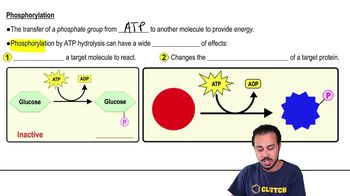
Phosphorylation is the transfer of a phosphate group from ATP to another molecule, often altering the molecule's activity or function.
Why is ATP considered a high-energy molecule?
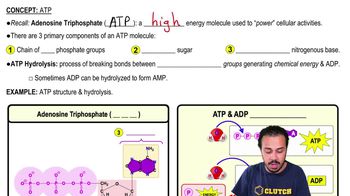
ATP is considered high-energy because the bonds between its phosphate groups store significant potential energy, which is released upon hydrolysis.
What are the two components of the adenosine part of ATP?
The adenosine part consists of a pentose sugar and an adenine nitrogenous base.
What is the role of water in ATP hydrolysis?
Water is used to break the bond between phosphate groups in ATP during hydrolysis.
What is an exergonic reaction and how is ATP hydrolysis classified?
An exergonic reaction releases energy; ATP hydrolysis is an exergonic reaction.
What is the function of the phosphate group released during ATP hydrolysis?
The released phosphate group can be transferred to other molecules, often altering their activity through phosphorylation.
Can phosphorylation both activate and inactivate molecules?
Yes, phosphorylation can either activate or inactivate target molecules, depending on the context.
What is the chemical formula for the process of ATP hydrolysis?
ATP + H2O → ADP + Pi + energy
How does the energy from food ultimately power cellular work?
Energy from food is used to synthesize ATP, which is then hydrolyzed to power cellular work.
What is the significance of the pentose sugar in ATP?
The pentose sugar forms part of the adenosine structure, linking the adenine base to the phosphate groups.
What happens to the phosphate group after it is released from ATP?
The phosphate group can be attached to other molecules, modifying their activity through phosphorylation.
Why is ATP often called the 'energy currency' of the cell?
ATP is called the 'energy currency' because it stores and transfers energy for nearly all cellular processes.
What is the difference between exergonic and endergonic reactions?
Exergonic reactions release energy, while endergonic reactions require an input of energy.
How does ATP hydrolysis relate to metabolic pathways?
ATP hydrolysis provides the energy needed to drive various steps in metabolic pathways.
What is the effect of ATP hydrolysis on the conformation of proteins?
ATP hydrolysis can lead to phosphorylation, which may change a protein's conformation and function.
What is the role of ATP in activating glucose for metabolism?
ATP phosphorylates glucose, converting it to an active form that can participate in metabolic reactions.
How does the number of phosphate groups in ATP, ADP, and AMP affect their energy content?
ATP has the most energy due to three phosphate groups; ADP and AMP have progressively less energy with fewer phosphate groups.
What is the importance of the adenine base in ATP?
The adenine base is part of the adenosine structure, which, along with the pentose sugar, forms the backbone of ATP.
How does ATP hydrolysis contribute to homeostasis in cells?
ATP hydrolysis provides energy for processes that maintain cellular homeostasis, such as active transport and biosynthesis.
What is meant by the term 'phosphorylated intermediate'?
A phosphorylated intermediate is a molecule that has received a phosphate group from ATP, often making it more reactive.
How does ATP hydrolysis link catabolic and anabolic pathways?
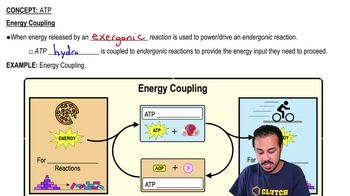
ATP hydrolysis links catabolic (energy-releasing) and anabolic (energy-consuming) pathways by transferring energy from one to the other.
What is the role of ATP in signal transduction pathways?
ATP provides phosphate groups for phosphorylation, which can activate or deactivate proteins in signal transduction pathways.
Why is the hydrolysis of ATP considered an exergonic reaction?
ATP hydrolysis is exergonic because it releases free energy that can be used to do cellular work.
What is the primary energy molecule used to power cellular activities, including photosynthesis?
Adenosine triphosphate (ATP) is the primary energy molecule used to power cellular activities, including photosynthesis.
 뒤로
뒤로

 04:57
04:57