Skip to main content
General Biology
나의 코스
배우기
시험 준비
AI 튜터
학습 가이드
교과서적 해결책
플래시카드
탐험해 보세요
앱을 사용해 보세요
나의 코스
배우기
시험 준비
AI 튜터
학습 가이드
교과서적 해결책
플래시카드
탐험해 보세요
앱을 사용해 보세요
뒤로
Carbon quiz #3
카드를 뒤집기 위해 탭할 수 있습니다.
What defines an organic molecule in biological systems?
카드를 뒤집기 위해 탭할 수 있습니다.
👆
What defines an organic molecule in biological systems?
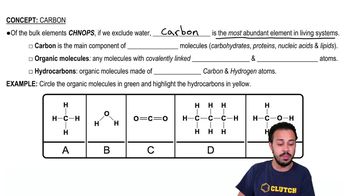
An organic molecule is defined as any molecule that contains covalently linked carbon and hydrogen atoms.
진행 상황 추적
컨트롤 버튼이 '내비게이션' 모드로 변경되었습니다.
1/10
관련 플래시카드
관련 실천
추천 영상
Carbon definitions
Carbon
16 용어
Carbon quiz #1
Carbon
17 용어
Carbon exam
Carbon
28 용어
Carbon
4. Biomolecules
4 문제점
주제
Jason
Functional Groups
4. Biomolecules
3 문제점
주제
Jason
4. Biomolecules - Part 1 of 2
5 주제
10 문제점
장
Jason
4. Biomolecules - Part 2 of 2
4 주제
10 문제점
장
Jason
03:35
Carbon is an Excellent Building Block
19742
views
723
rank
04:19
Carbon
26214
views
572
rank
2
comments
이 집합의 용어 (10)
하이드의 정의
What defines an organic molecule in biological systems?
An organic molecule is defined as any molecule that contains covalently linked carbon and hydrogen atoms.
List the four major classes of organic macromolecules that have carbon as their main component.
The four major classes of organic macromolecules are carbohydrates, proteins, nucleic acids, and lipids.
Describe four ways in which carbon backbones can vary in organic molecules.
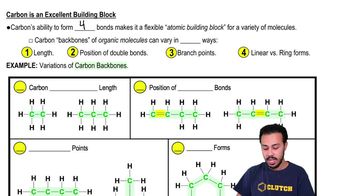
Carbon backbones can vary in length, the position of double bonds, the presence of branching, and whether they are linear or form rings.
Explain why carbon dioxide (CO2) is not classified as an organic molecule.
Carbon dioxide is not classified as an organic molecule because it lacks covalently linked carbon and hydrogen atoms.
What defines an organic molecule in biological systems?
An organic molecule is any molecule that contains covalently linked carbon and hydrogen atoms.
List the four major classes of organic macromolecules that have carbon as their main component.
The four major classes are carbohydrates, proteins, nucleic acids, and lipids.
Describe four ways in which carbon backbones can vary in organic molecules.
Carbon backbones can vary in length, the position of double bonds, the presence of branching, and whether they are linear or form rings.
Explain why carbon dioxide (CO2) is not classified as an organic molecule.
CO2 is not classified as an organic molecule because it lacks covalently linked carbon and hydrogen atoms.
What is a hydrocarbon, and how does it differ from other organic molecules?
A hydrocarbon is an organic molecule made only of carbon and hydrogen atoms, while other organic molecules may contain additional elements.
Why is carbon considered an excellent building block for biological molecules?
Carbon can form four covalent bonds, allowing for a wide variety of molecular structures and complexity in biological molecules.
 뒤로
뒤로
 03:35
03:35