 뒤로
뒤로Characteristics of Life definitions


 09:26
09:26
이 집합의 용어 (9)
Cells
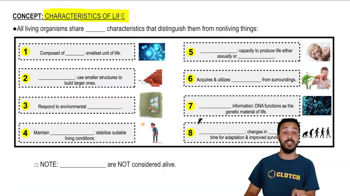
The smallest fundamental unit of life, capable of performing all life processes, and forming the basis of all living organisms.
Organization
The hierarchical arrangement of smaller structures into larger, more complex systems, enabling living organisms to function and survive.
Homeostasis
The ability of living organisms to maintain stable internal conditions despite external environmental changes.
Genetic Information
Hereditary information encoded in DNA, passed from one generation to the next, guiding development, functioning, and reproduction of all living organisms.
DNA
A molecule that carries genetic information, enabling inheritance and guiding the development, functioning, and reproduction of all living organisms.
Evolution
Changes in a population's DNA over long periods, enabling adaptation and improved survival in their environment.
Meiosis
A type of cell division that reduces the chromosome number by half, creating four genetically diverse haploid cells, essential for sexual reproduction.
Population
A group of individuals of the same species living in a specific area, capable of interbreeding and sharing genetic information.
Virus
A microscopic infectious agent that requires a host cell to replicate, lacking cellular structure and independent metabolic processes, thus not considered alive.