General Biology
나의 코스
배우기
시험 준비
AI 튜터
학습 가이드
교과서적 해결책
플래시카드
탐험해 보세요
앱을 사용해 보세요
나의 코스
배우기
시험 준비
AI 튜터
학습 가이드
교과서적 해결책
플래시카드
탐험해 보세요
앱을 사용해 보세요
뒤로
Introduction to Evolution and Natural Selection exam
1 학생이 이 점이 도움이 되었다고 느꼈습니다
카드를 뒤집기 위해 탭할 수 있습니다.
Evolution
카드를 뒤집기 위해 탭할 수 있습니다.
👆
Evolution
The gradual change of populations over time, defined by 'descent with modification.'
진행 상황 추적
컨트롤 버튼이 '내비게이션' 모드로 변경되었습니다.
1/28
관련 플래시카드
관련 실천
추천 영상
Descent with Modification definitions
Introduction to Evolution and Natural Selection
15 용어
Descent with Modification quiz #1
Introduction to Evolution and Natural Selection
18 용어
Introduction to Evolution and Natural Selection quiz #2
Introduction to Evolution and Natural Selection
38 용어
Descent with Modification
21. Evolution
4 문제점
주제
Jason
History of Evolutionary Thought
21. Evolution
5 문제점
주제
21. Evolution by Natural Selection - Part 1 of 2
4 주제
9 문제점
장
Jason
21. Evolution - Part 2 of 2
2 주제
5 문제점
장
03:22
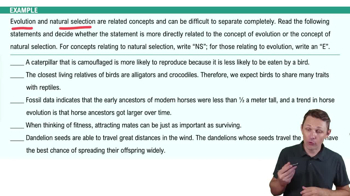
Introduction to Evolution and Natual Selection Example 1
5769
views
133
rank
04:28
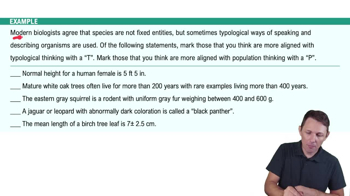
Introduction to Evolution and Natual Selection Example 2
4031
views
42
rank
2
comments
03:56
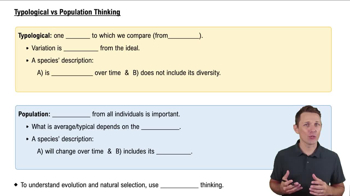
Typological vs. Population Thinking
5036
views
80
rank
이 집합의 용어 (28)
하이드의 정의
Evolution
The gradual change of populations over time, defined by 'descent with modification.'
Natural Selection
A key mechanism of evolution that favors traits enhancing survival and reproduction.
Descent with Modification
The process by which species change over time, passing traits from ancestors to descendants.
What is common descent?
The idea that species alive today share common ancestors.
Phylogenetic Tree
A diagram showing the evolutionary relationships among various species based on common descent.
What does 'fitness' mean in the context of evolution?
The likelihood that an individual contributes offspring to the next generation.
Adaptation
A trait that makes an organism well-suited to its environment.
What is typological thinking?
A way of thinking that compares organisms to an idealized form, viewing variation as deviation.
Population Thinking
A way of thinking that considers variation among individuals as important and defines species by this variation.
Ladder Thinking
A hierarchical view of species complexity, historically influenced by Aristotle's Scala Naturae.
Tree Thinking
A view that focuses on species relationships through common descent without a hierarchy of complexity.
What are branches in a phylogenetic tree?
Lines representing a population over time as it changes and evolves.
Nodes in a Phylogenetic Tree
Points where branches meet, representing common ancestors of different populations.
Survival of the Fittest
A phrase summarizing natural selection, where the fittest individuals survive and reproduce.
What does 'variation' mean in population thinking?
The differences among individuals within a population, which are crucial for defining species.
How does natural selection lead to adaptation?
Traits that enhance survival and reproduction become more common, leading to adaptations.
What is the significance of evolutionary trees?
They help understand species relationships and evolutionary history based on common descent.
What is the main difference between ladder and tree thinking?
Ladder thinking views species hierarchically by complexity, while tree thinking focuses on evolutionary relationships.
How do you read a phylogenetic tree?
Focus on how branches connect at nodes, representing common ancestors.
What is the role of variation in evolution?
Variation among individuals is essential for natural selection to act upon, leading to evolution.
What does 'descent' refer to in 'descent with modification'?
The passing of traits from parents to offspring over generations.
How does common descent explain species similarities?
Species share traits because they have inherited them from a common ancestor.
What is the importance of fitness in natural selection?
Individuals with higher fitness are more likely to reproduce and pass on their traits.
What is the significance of nodes in evolutionary trees?
They indicate the last common ancestor shared by different populations.
How does tree thinking help in understanding species variation?
It explains variation through shared evolutionary histories and common descent.
What is the relationship between adaptation and environment?
Adaptations are traits that make an organism well-suited to its specific environment.
Why is population thinking crucial for understanding evolution?
It emphasizes the importance of variation among individuals in a population.
What does 'hierarchy of complexity' refer to in ladder thinking?
The idea that species can be ranked by their level of complexity, from simple to complex.