Skip to main content
General Biology
나의 코스
배우기
시험 준비
AI 튜터
학습 가이드
교과서적 해결책
플래시카드
탐험해 보세요
앱을 사용해 보세요
나의 코스
배우기
시험 준비
AI 튜터
학습 가이드
교과서적 해결책
플래시카드
탐험해 보세요
앱을 사용해 보세요
뒤로
Discovering the Structure of DNA exam
2 학생들은 이 점이 도움이 되었다고 느꼈습니다
카드를 뒤집기 위해 탭할 수 있습니다.
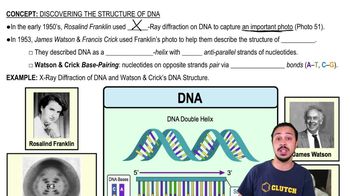
Photo 51
카드를 뒤집기 위해 탭할 수 있습니다.
👆
Photo 51
An x-ray diffraction image of DNA taken by Rosalind Franklin, providing crucial evidence for the double helix structure.
진행 상황 추적
컨트롤 버튼이 '내비게이션' 모드로 변경되었습니다.
1/28
관련 플래시카드
관련 실천
추천 영상
Discovering the Structure of DNA definitions
Discovering the Structure of DNA
14 용어
Discovering the Structure of DNA quiz #1
Discovering the Structure of DNA
14 용어
Discovering the Structure of DNA quiz #2
Discovering the Structure of DNA
38 용어
Discovering the Structure of DNA
14. DNA Synthesis
4 문제점
주제
Jason
Meselson-Stahl Experiment
14. DNA Synthesis
2 문제점
주제
Jason
14. DNA Synthesis - Part 1 of 2
7 주제
10 문제점
장
Brendan
14. DNA Synthesis - Part 2 of 2
5 주제
10 문제점
장
Brendan
06:24
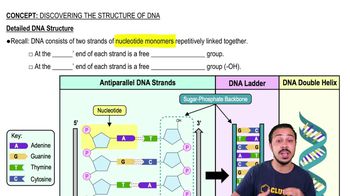
Detailed DNA Structure
13303
views
172
rank
1
comments
04:41
Discovering the Structure of DNA
14127
views
166
rank
이 집합의 용어 (28)
하이드의 정의
Photo 51
An x-ray diffraction image of DNA taken by Rosalind Franklin, providing crucial evidence for the double helix structure.
Who discovered the double helix structure of DNA?
James Watson and Francis Crick in 1953.
Antiparallel
Refers to the opposite orientation of the two DNA strands, with one running 5' to 3' and the other 3' to 5'.
What are the components of a nucleotide?
A phosphate group, a five-carbon sugar, and a nitrogenous base.
Watson and Crick base pairing
Adenine pairs with thymine, and cytosine pairs with guanine via hydrogen bonds.
What is the significance of Rosalind Franklin's work?
Her x-ray diffraction image, Photo 51, was key evidence for the double helix structure of DNA.
Hydrogen bonds in DNA
The bonds that link the nitrogenous bases of the two DNA strands, stabilizing the double helix structure.
What does the sugar-phosphate backbone consist of?
A repetitive sequence of sugar and phosphate groups forming the structural framework of DNA.
Double helix
The twisted ladder-like structure of DNA, consisting of two antiparallel strands.
What are the nitrogenous bases in DNA?
Adenine (A), Thymine (T), Cytosine (C), and Guanine (G).
5' end of DNA
The end of a DNA strand with a free phosphate group.
What is the 3' end of DNA?
The end of a DNA strand with a free hydroxyl group.
Rosalind Franklin
A scientist who used x-ray diffraction to capture Photo 51, crucial for discovering DNA's structure.
What is the role of hydrogen bonds in DNA?
They connect the nitrogenous bases of the two DNA strands, maintaining the double helix structure.
Phosphate group
A component of a nucleotide, part of the sugar-phosphate backbone in DNA.
What does antiparallel mean in the context of DNA?
The two DNA strands run in opposite directions, one 5' to 3' and the other 3' to 5'.
Five-carbon sugar in DNA
Deoxyribose, a component of a nucleotide.
What is the function of the sugar-phosphate backbone?
It provides structural support to the DNA molecule.
Nitrogenous base
A component of a nucleotide; includes adenine, thymine, cytosine, and guanine.
What is the structure of DNA?
A double helix with two antiparallel strands of nucleotides.
Adenine
A nitrogenous base in DNA that pairs with thymine.
What pairs with cytosine in DNA?
Guanine.
Thymine
A nitrogenous base in DNA that pairs with adenine.
What is the significance of Watson and Crick's model?
It accurately described the double helix structure of DNA and the base pairing rules.
Cytosine
A nitrogenous base in DNA that pairs with guanine.
What is the role of nucleotides in DNA?
They are the building blocks of DNA, forming the strands through repetitive linkage.
Guanine
A nitrogenous base in DNA that pairs with cytosine.
What does the term 'double helix' refer to?
The spiral structure formed by two strands of DNA.
 뒤로뒤로
뒤로뒤로

 06:24
06:24