Skip to main content
General Biology
나의 코스
배우기
시험 준비
AI 튜터
학습 가이드
교과서적 해결책
플래시카드
탐험해 보세요
앱을 사용해 보세요
나의 코스
배우기
시험 준비
AI 튜터
학습 가이드
교과서적 해결책
플래시카드
탐험해 보세요
앱을 사용해 보세요
뒤로
Enzymes quiz #4
카드를 뒤집기 위해 탭할 수 있습니다.
How do enzymes affect the rate of chemical reactions?
카드를 뒤집기 위해 탭할 수 있습니다.
👆
How do enzymes affect the rate of chemical reactions?
Enzymes increase the rate of chemical reactions, allowing them to occur much faster than they would without enzymes.
진행 상황 추적
컨트롤 버튼이 '내비게이션' 모드로 변경되었습니다.
1/27
관련 플래시카드
관련 실천
추천 영상
Enzymes definitions
Enzymes
10 용어
Enzymes quiz #1
Enzymes
30 용어
Enzymes exam
Enzymes
29 용어
Enzymes
7. Energy and Metabolism
6 문제점
주제
Jason
Enzyme Activation Energy
7. Energy and Metabolism
5 문제점
주제
Jason
7. Energy and Metabolism
10 주제
13 문제점
장
Brendan
02:32
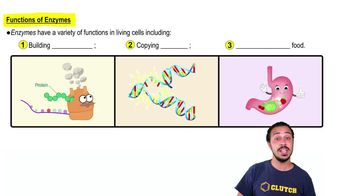
Functions of Enzymes
18941
views
295
rank
1
comments
02:25
Enzymes Example 1
15219
views
194
rank
02:55
Enzymes
20990
views
356
rank
이 집합의 용어 (27)
하이드의 정의
How do enzymes affect the rate of chemical reactions?
Enzymes increase the rate of chemical reactions, allowing them to occur much faster than they would without enzymes.
What happens to an enzyme after it catalyzes a reaction?
The enzyme remains unchanged and can be reused for subsequent reactions.
How does temperature affect enzyme activity?
Enzyme activity increases with temperature up to an optimal point, but high or low temperatures can decrease activity and may denature the enzyme.
How does pH influence enzyme activity?
Enzymes have an optimal pH; deviations from this pH can reduce activity and may denature the enzyme.
Why are enzymes essential for life?
Enzymes are essential because they speed up biochemical reactions to rates that sustain life.
What is the relationship between enzyme structure and function?
An enzyme's specific shape determines its function; loss of shape (denaturation) leads to loss of function.
What happens if an enzyme is exposed to extreme heat?
Extreme heat can denature the enzyme, causing it to lose its shape and function.
How are enzymes involved in DNA replication?
Enzymes catalyze the copying of DNA, ensuring accurate and efficient replication.
What is meant by enzyme activity?
Enzyme activity refers to the amount of product produced by an enzyme in a given time.
What can happen if the pH is too acidic or too basic for an enzyme?
If the pH is too acidic or too basic, the enzyme may denature and lose its activity.
What is the difference between a substrate and a product in an enzymatic reaction?
A substrate is the reactant that the enzyme acts on, while the product is the result of the enzymatic reaction.
What happens to enzyme activity if the substrate concentration is very low?
Enzyme activity is low because there are not enough substrates for the enzyme to act on.
How do enzymes contribute to metabolic pathways?
Enzymes catalyze each step in metabolic pathways, ensuring efficient and regulated biochemical reactions.
How does enzyme denaturation affect living organisms?
Denatured enzymes lose their function, which can disrupt essential biochemical processes in living organisms.
What is the role of ribosomes as enzymes?
Ribosomes act as enzymes that catalyze the synthesis of proteins from amino acids.
What is meant by the term 'catalyze' in relation to enzymes?
'Catalyze' means to speed up a chemical reaction without being consumed in the process.
How does enzyme concentration affect the rate of reaction?
Increasing enzyme concentration generally increases the reaction rate, provided there is enough substrate.
Why is enzyme structure important for its function?
The specific three-dimensional structure of an enzyme determines its ability to bind substrates and catalyze reactions.
What is the effect of a neutral pH on most enzymes?
Many enzymes function optimally at or near neutral pH, but this can vary depending on the enzyme.
What is the consequence of enzyme oversaturation with substrate?
Once all enzyme active sites are occupied, increasing substrate concentration further does not increase the reaction rate.
How do enzymes maintain efficiency in biochemical reactions?
Enzymes lower the activation energy required, allowing reactions to proceed quickly and efficiently.
What is the main difference between reactants and substrates?
Reactants are general starting materials in any reaction, while substrates specifically refer to reactants in enzyme-catalyzed reactions.
How does enzyme denaturation impact its catalytic ability?
Denaturation alters the enzyme's shape, preventing it from binding substrates and catalyzing reactions.
What environmental factors can cause enzyme denaturation?
Extreme temperatures and pH levels can cause enzyme denaturation.
Why is it important for cells to regulate enzyme activity?
Regulating enzyme activity ensures that biochemical reactions occur at appropriate rates for cellular needs.
What is the outcome if an enzyme loses its shape?
If an enzyme loses its shape, it loses its function and cannot catalyze reactions.
How do enzymes contribute to the efficiency of DNA replication?
Enzymes speed up the process of copying DNA, ensuring accurate and timely replication.
 뒤로
뒤로

 02:32
02:32