Skip to main content
General Biology
나의 코스
배우기
시험 준비
AI 튜터
학습 가이드
교과서적 해결책
플래시카드
탐험해 보세요
앱을 사용해 보세요
나의 코스
배우기
시험 준비
AI 튜터
학습 가이드
교과서적 해결책
플래시카드
탐험해 보세요
앱을 사용해 보세요
뒤로
Geographic Impact on Communities definitions
카드를 뒤집기 위해 탭할 수 있습니다.
Latitude
카드를 뒤집기 위해 탭할 수 있습니다.
👆
Latitude
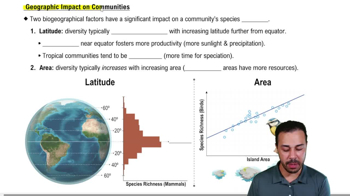
A geographic coordinate that influences climate and species diversity, with diversity typically decreasing further from the equator.
진행 상황 추적
컨트롤 버튼이 '내비게이션' 모드로 변경되었습니다.
1/15
관련 플래시카드
관련 실천
추천 영상
Geographic Impact on Communities exam
Geographic Impact on Communities
29 용어
Geographic Impact on Communities quiz #2
Geographic Impact on Communities
10 용어
Geographic Impact on Communities
51. Community Ecology
5 문제점
주제
Community Dynamics
51. Community Ecology
4 문제점
주제
51. Community Ecology - Part 1 of 2
4 주제
12 문제점
장
Jason
51. Community Ecology - Part 2 of 2
4 주제
10 문제점
장
03:48
What is the Island Equilibrium Model?
1349
views
8
rank
03:54
Geographic Impact on Communities Example 2
1354
views
5
rank
03:35
Geographic Impact on Communities
1302
views
11
rank
이 집합의 용어 (15)
하이드의 정의
Latitude
A geographic coordinate that influences climate and species diversity, with diversity typically decreasing further from the equator.
Area
A spatial factor affecting species diversity, where larger regions support more species due to increased resources and habitats.
Species Diversity
A measure reflecting both the number and variety of species within a community, shaped by geographic and ecological factors.
Species Richness
A count of different species present in a community, often used to compare biodiversity across regions.
Equator
A region receiving the most direct sunlight and precipitation, fostering high biological productivity and species diversity.
Glaciation
A historical process that resets communities at higher latitudes, reducing species diversity compared to tropical regions.
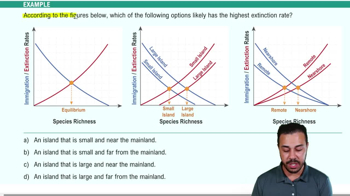
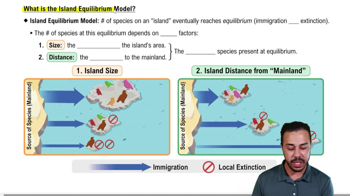
Island Equilibrium Model
A concept describing how species numbers on islands stabilize when immigration balances extinction, influenced by size and distance.
Immigration Rate
The frequency at which new species arrive in a community, higher on larger or closer islands.
Extinction Rate
The frequency at which species disappear from a community, often higher on smaller or more isolated islands.
Mainland
A primary source of species for islands, with proximity affecting immigration and species richness on nearby islands.
Microhabitat
A small, specialized environment within a larger area, supporting unique species and contributing to overall diversity.
Disturbance
An event that alters species numbers in a community, after which equilibrium is gradually restored.
Patch
An isolated area of habitat, such as a lake or mountain peak, where island equilibrium principles can apply.
Tropical Community
A biologically rich region near the equator, typically older and less affected by glaciation, supporting high species diversity.
Habitat
A physical environment providing resources and conditions necessary for species survival and diversity.
 뒤로뒤로
뒤로뒤로
 03:48
03:48