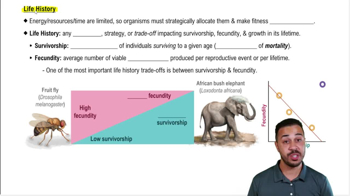
How is survivorship defined in life history studies?
Survivorship is the proportion of individuals in a population that survive to a given age, representing the opposite of mortality.
Describe the trade-off between survivorship and fecundity in life history strategies.
There is a trade-off where high survivorship usually comes at the cost of low fecundity, and high fecundity often results in low survivorship.
Contrast the life history traits of African bush elephants with those of fruit flies.
African bush elephants have high survivorship and low fecundity, producing few offspring that mostly survive to adulthood, while fruit flies have low survivorship and high fecundity.
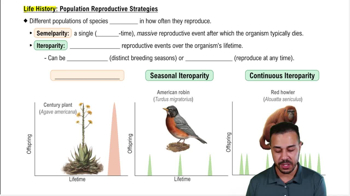
Define iteroparity and distinguish between its seasonal and continuous forms.
Iteroparity is a reproductive strategy involving multiple reproductive events throughout an organism's life. Seasonal iteroparity occurs during specific breeding seasons, while continuous iteroparity allows reproduction at any time.
How do reproductive strategies like semelparity and iteroparity affect the number and timing of offspring produced?
Semelparity results in one large reproductive event with many offspring at the end of life, while iteroparity involves multiple, smaller reproductive events spread throughout the organism's life.
How is survivorship defined in life history studies?
Survivorship is the proportion of individuals in a population that survive to a given age, representing the opposite of mortality.
Describe the trade-off between survivorship and fecundity in life history strategies.
There is a trade-off where high survivorship usually comes at the cost of low fecundity, and high fecundity often results in low survivorship.
Contrast the life history traits of African bush elephants with those of fruit flies.
African bush elephants have high survivorship and low fecundity, producing few offspring that mostly survive to adulthood, while fruit flies have low survivorship and high fecundity.
Define iteroparity and distinguish between its seasonal and continuous forms.
Iteroparity is a reproductive strategy involving multiple reproductive events throughout an organism's life. Seasonal iteroparity occurs during specific breeding seasons, while continuous iteroparity allows reproduction at any time.
How do reproductive strategies like semelparity and iteroparity affect the number and timing of offspring produced?
Semelparity results in one large reproductive event with many offspring at the end of life, while iteroparity involves multiple, smaller reproductive events spread throughout the organism's life.
 뒤로
뒤로
 04:01
04:01