Skip to main content
General Biology
나의 코스
배우기
시험 준비
AI 튜터
학습 가이드
교과서적 해결책
플래시카드
탐험해 보세요
앱을 사용해 보세요
나의 코스
배우기
시험 준비
AI 튜터
학습 가이드
교과서적 해결책
플래시카드
탐험해 보세요
앱을 사용해 보세요
뒤로
Meselson-Stahl Experiment exam
카드를 뒤집기 위해 탭할 수 있습니다.
Meselson-Stahl Experiment
카드를 뒤집기 위해 탭할 수 있습니다.
👆
Meselson-Stahl Experiment
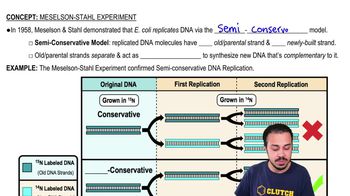
An experiment that demonstrated DNA replication follows the semiconservative model.
진행 상황 추적
컨트롤 버튼이 '내비게이션' 모드로 변경되었습니다.
1/28
관련 플래시카드
관련 실천
추천 영상
Meselson-Stahl Experiment definitions
Meselson-Stahl Experiment
15 용어
Meselson-Stahl Experiment quiz #1
Meselson-Stahl Experiment
10 용어
Meselson-Stahl Experiment quiz #2
Meselson-Stahl Experiment
12 용어
Meselson-Stahl Experiment
14. DNA Synthesis
2 문제점
주제
Jason
Introduction to DNA Replication
14. DNA Synthesis
2 문제점
주제
Jason
14. DNA Synthesis - Part 1 of 2
7 주제
10 문제점
장
Brendan
14. DNA Synthesis - Part 2 of 2
5 주제
10 문제점
장
Brendan
09:03
Meselson-Stahl Experiment
11825
views
126
rank
이 집합의 용어 (28)
하이드의 정의
Meselson-Stahl Experiment
An experiment that demonstrated DNA replication follows the semiconservative model.
Semiconservative Model
A model of DNA replication where each new DNA molecule consists of one parental strand and one newly synthesized strand.
What isotopes were used in the Meselson-Stahl experiment?
Nitrogen-15 (N15) for old strands and Nitrogen-14 (N14) for new strands.
Conservative Model
A disproven model of DNA replication where the original DNA molecule is conserved and new molecules are entirely new.
Dispersive Model
A disproven model of DNA replication where the original DNA molecule is dispersed throughout the new molecules.
What organism did Meselson and Stahl use in their experiment?
Escherichia coli (E. coli).
What does the semiconservative model imply about the parental DNA strands?
They act as templates for the synthesis of new complementary strands.
Nitrogen-15 (N15)
An isotope used to label old or parental DNA strands in the Meselson-Stahl experiment.
Nitrogen-14 (N14)
An isotope used to label newly synthesized DNA strands in the Meselson-Stahl experiment.
What was the main conclusion of the Meselson-Stahl experiment?
DNA replicates via the semiconservative model.
What did the conservative model suggest about DNA replication?
The original DNA molecule remains conserved, and new molecules are entirely new.
What did the dispersive model suggest about DNA replication?
The original DNA molecule is dispersed throughout the new molecules.
What was the key visual indicator in the Meselson-Stahl experiment?
The use of different nitrogen isotopes (N15 and N14) to distinguish old and new DNA strands.
What did Meselson and Stahl switch E. coli to after growing them in N15?
Media containing Nitrogen-14 (N14).
What does the term 'semiconservative' mean in the context of DNA replication?
Partially conservative; each new DNA molecule has one old strand and one new strand.
What was disproven by the Meselson-Stahl experiment?
The conservative and dispersive models of DNA replication.
What color represented N15-labeled DNA strands in the experiment?
Darker blue.
What color represented N14-labeled DNA strands in the experiment?
Light blue.
What is the significance of the Meselson-Stahl experiment in molecular biology?
It provided foundational understanding of DNA replication, crucial for grasping genetic inheritance.
Who were the scientists behind the Meselson-Stahl experiment?
Matthew Meselson and Franklin Stahl.
What year was the Meselson-Stahl experiment conducted?
1958.
What does the semiconservative model ensure during DNA replication?
Each new DNA molecule is identical to the original, ensuring accurate genetic inheritance.
What was the initial growth condition for E. coli in the experiment?
Grown in Nitrogen-15 (N15) isotope.
What happens to the parental DNA strands during semiconservative replication?
They separate and act as templates for new complementary strands.
What did the green check mark indicate in the experiment's results?
Confirmation that the semiconservative model is the correct model of DNA replication.
What did the red X's indicate in the experiment's results?
Disproval of the conservative and dispersive models of DNA replication.
What is the role of complementary base pairing in semiconservative replication?
Ensures that new DNA strands are accurately synthesized based on the parental template.
What is the primary takeaway from the Meselson-Stahl experiment?
DNA replication is semiconservative, with each new molecule containing one old and one new strand.
 뒤로뒤로
뒤로뒤로

 09:03
09:03