Skip to main content
General Biology
나의 코스
배우기
시험 준비
AI 튜터
학습 가이드
교과서적 해결책
플래시카드
탐험해 보세요
앱을 사용해 보세요
나의 코스
배우기
시험 준비
AI 튜터
학습 가이드
교과서적 해결책
플래시카드
탐험해 보세요
앱을 사용해 보세요
뒤로
Metabolism and Homeostasis exam
카드를 뒤집기 위해 탭할 수 있습니다.
Metabolism
카드를 뒤집기 위해 탭할 수 있습니다.
👆
Metabolism
The sum of the chemical processes that occur within a living organism to maintain life.
진행 상황 추적
컨트롤 버튼이 '내비게이션' 모드로 변경되었습니다.
1/28
관련 플래시카드
관련 실천
추천 영상
Metabolism and Homeostasis quiz #1
Metabolism and Homeostasis
37 용어
Metabolism and Homeostasis definitions
Metabolism and Homeostasis
9 용어
Metabolism and Homeostasis quiz #1
Metabolism and Homeostasis
40 용어
Metabolism and Homeostasis
38. Animal Form and Function
7 문제점
주제
Jason
Thermoregulation
38. Animal Form and Function
7 문제점
주제
Jason
38. Animal Form and Function
3 주제
8 문제점
장
Jason
07:47
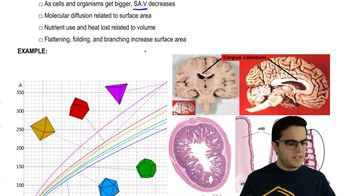
Surface Area to Volume Ratio
3697
views
19
rank
08:57
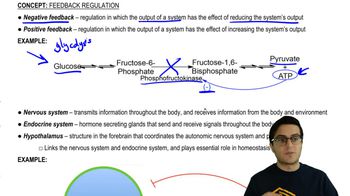
Feedback Regulation
2550
views
18
rank
11:49
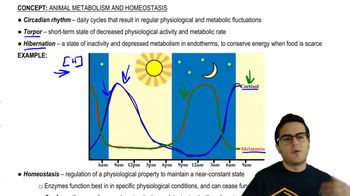
Homeostasis
2791
views
18
rank
1
comments
이 집합의 용어 (28)
하이드의 정의
Metabolism
The sum of the chemical processes that occur within a living organism to maintain life.
What is homeostasis?
The regulation of an organism's internal environment to maintain stable, optimal conditions.
Surface area to volume ratio
A ratio that decreases as organisms get larger, affecting diffusion efficiency and metabolic rates.
Why do larger animals have lower metabolic rates per unit mass compared to smaller animals?
Larger animals lose less heat relative to their volume, requiring less energy per unit mass to maintain body temperature.
Circadian rhythms
Daily cycles that regulate physiological and metabolic processes, such as hormone levels.
What hormone peaks in the morning to increase alertness?
Cortisol
Negative feedback
A regulatory mechanism where the output of a system reduces the activity of the system.
How does negative feedback maintain homeostasis?
By reducing the output of a system when it exceeds a set point, thus maintaining balance.
Basal metabolic rate (BMR)
The minimum rate of energy consumption of an endotherm at rest.
What is the main difference between basal metabolic rate and standard metabolic rate?
BMR is for endotherms at rest, while SMR is for ectotherms at rest.
HPA axis
The hypothalamic-pituitary-adrenal axis, a system that regulates stress responses via hormone release.
What is the role of the hypothalamus in the HPA axis?
It releases corticotropin-releasing hormone (CRH) to stimulate the pituitary gland.
Positive feedback
A regulatory mechanism where the output of a system increases the activity of the system.
Give an example of positive feedback in the body.
Labor contractions during childbirth.
Conformers
Organisms that do not actively regulate their internal environment but conform to external conditions.
What is the main function of melatonin?
To promote sleep and regulate sleep-wake cycles.
Regulators
Organisms that actively control their internal environment to maintain homeostasis.
Why do smaller animals have higher relative metabolic rates?
They lose more heat relative to their volume and need more energy to maintain body temperature.
Set point
The ideal value or range that a homeostatic system aims to maintain.
What is the role of sensors in homeostasis?
To detect changes in the internal or external environment and send information to the integrator.
Integrator
The component of a homeostatic system that processes sensory information and determines the appropriate response.
Effector
The component of a homeostatic system that generates a response to restore optimal conditions.
What is the main stress hormone in the body?
Cortisol
How does the body increase surface area for absorption in the intestines?
Through folding, villi, and microvilli.
What is torpor?
A short-term state of decreased physiological activity and metabolic rate.
Why is homeostasis important for enzyme function?
Enzymes require specific conditions to function properly, and homeostasis maintains these conditions.
What happens to metabolic rate as body size increases?
The relative metabolic rate decreases.
How does the body regulate temperature through homeostasis?
By using sensors to detect temperature changes, an integrator to process this information, and effectors like sweat glands to cool the body.
 뒤로뒤로
뒤로뒤로
 07:47
07:47