Skip to main content
General Biology
나의 코스
배우기
시험 준비
AI 튜터
학습 가이드
교과서적 해결책
플래시카드
탐험해 보세요
앱을 사용해 보세요
나의 코스
배우기
시험 준비
AI 튜터
학습 가이드
교과서적 해결책
플래시카드
탐험해 보세요
앱을 사용해 보세요
뒤로
Mitosis & Meiosis Review quiz #4
카드를 뒤집기 위해 탭할 수 있습니다.
What is the result of mitosis in terms of daughter cell genetic identity?
카드를 뒤집기 위해 탭할 수 있습니다.
👆
What is the result of mitosis in terms of daughter cell genetic identity?
Mitosis produces two genetically identical daughter cells.
진행 상황 추적
컨트롤 버튼이 '내비게이션' 모드로 변경되었습니다.
1/26
관련 플래시카드
관련 실천
추천 영상
Mitosis & Meiosis Review definitions
Mitosis & Meiosis Review
10 용어
Mitosis & Meiosis Review quiz #1
Mitosis & Meiosis Review
19 용어
Mitosis & Meiosis Review quiz #2
Mitosis & Meiosis Review
37 용어
Mitosis & Meiosis Review
12. Meiosis
1 문제
주제
Brendan
Genetic Variation During Meiosis
12. Meiosis
7 문제점
주제
Jason
12. Meiosis
8 주제
15 문제점
장
Jason
01:27
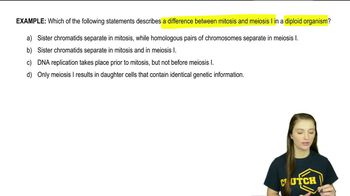
Mitosis & Meiosis Review Example 1
9933
views
99
rank
3
comments
이 집합의 용어 (26)
하이드의 정의
What is the result of mitosis in terms of daughter cell genetic identity?
Mitosis produces two genetically identical daughter cells.
Does DNA replication occur before both mitosis and meiosis?
Yes, DNA replication occurs before both mitosis and meiosis.
What type of cells are produced by mitosis?
Mitosis produces somatic (body) cells.
How many rounds of cell division occur in mitosis?
Mitosis involves one round of cell division.
Are the daughter cells produced by meiosis genetically identical to the parent cell?
No, daughter cells from meiosis are genetically different from the parent cell.
What separates during meiosis II?
Sister chromatids separate during meiosis II.
What is the ploidy of cells after meiosis?
Cells are haploid after meiosis.
What ensures genetic variation during meiosis?
Genetic variation is ensured by crossing over and independent assortment during meiosis.
Does mitosis result in genetic variation?
No, mitosis does not result in genetic variation; it produces identical cells.
What is the function of mitosis in multicellular organisms?
Mitosis functions in growth, repair, and maintenance of tissues.
What is the function of meiosis in multicellular organisms?
Meiosis functions to produce gametes for sexual reproduction.
How many daughter cells are produced by mitosis?
Mitosis produces two daughter cells.
How many daughter cells are produced by meiosis?
Meiosis produces four daughter cells.
What happens to chromosome number during mitosis?
Chromosome number remains the same during mitosis.
What happens to chromosome number during meiosis?
Chromosome number is halved during meiosis.
When do homologous chromosomes pair up and exchange genetic material?
Homologous chromosomes pair up and exchange genetic material during prophase I of meiosis.
What is the significance of crossing over in meiosis?
Crossing over increases genetic diversity among gametes.
Which process involves the separation of sister chromatids?
Separation of sister chromatids occurs in mitosis and meiosis II.
Which process involves the separation of homologous chromosomes?
Separation of homologous chromosomes occurs in meiosis I.
What is the role of independent assortment in meiosis?
Independent assortment during meiosis increases genetic variation by randomly distributing maternal and paternal chromosomes.
Why do gametes have half the number of chromosomes as somatic cells?
Gametes have half the number of chromosomes to maintain the species' chromosome number after fertilization.
What would happen if meiosis did not reduce chromosome number?
If meiosis did not reduce chromosome number, chromosome number would double with each generation.
In which phase of meiosis does crossing over occur?
Crossing over occurs during prophase I of meiosis.
What is the end result of meiosis in terms of genetic content?
Meiosis results in four genetically unique haploid cells.
What is the end result of mitosis in terms of genetic content?
Mitosis results in two genetically identical diploid cells.
How does the process of mitosis differ from meiosis in terms of genetic outcomes?
Mitosis produces identical cells, while meiosis produces genetically diverse cells.
 뒤로뒤로


 01:27
