General Biology
나의 코스
배우기
시험 준비
AI 튜터
학습 가이드
교과서적 해결책
플래시카드
탐험해 보세요
앱을 사용해 보세요
나의 코스
배우기
시험 준비
AI 튜터
학습 가이드
교과서적 해결책
플래시카드
탐험해 보세요
앱을 사용해 보세요
뒤로
Natural Selection exam
카드를 뒤집기 위해 탭할 수 있습니다.
Natural Selection
카드를 뒤집기 위해 탭할 수 있습니다.
👆
Natural Selection
A key mechanism of evolution where certain traits enhance survival and reproduction, leading to evolutionary changes in populations over time.
진행 상황 추적
컨트롤 버튼이 '내비게이션' 모드로 변경되었습니다.
1/29
관련 플래시카드
관련 실천
추천 영상
Natural Selection quiz #1
Natural Selection
10 용어
Natural Selection definitions
Natural Selection
15 용어
Natural Selection
21. Evolution
5 문제점
주제
Evidence of Natural Selection
21. Evolution
5 문제점
주제
21. Evolution by Natural Selection - Part 1 of 2
4 주제
9 문제점
장
Jason
21. Evolution - Part 2 of 2
2 주제
5 문제점
장
05:11
Natural Selection Example 2
3163
views
18
rank
04:12
Natural Selection: Observations and Inferences
4140
views
41
rank
1
comments
02:19
Natural Selection Example 1
3262
views
23
rank
1
comments
이 집합의 용어 (29)
하이드의 정의
Natural Selection
A key mechanism of evolution where certain traits enhance survival and reproduction, leading to evolutionary changes in populations over time.
Observation 1 of Natural Selection
Variation is inherited; not all organisms in a population are identical, and much of this variation is passed from parent to offspring.
Observation 2 of Natural Selection
Species tend to overproduce offspring, more than the environment can support.
Inference 1 from Natural Selection Observations
Certain traits will make survival and reproduction more likely, while others will make them less likely.
Inference 2 from Natural Selection Observations
Traits that help organisms survive and reproduce will accumulate in the population, leading to evolution.
Example of Natural Selection
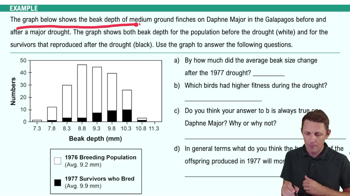
Snowshoe hares with coat color variation; white hares are less camouflaged in areas with little snow, leading to higher predation rates.
Adaptation
A trait that increases an organism's fitness in a particular environment.
Fitness
The likelihood that an organism is able to survive and reproduce.
Relative Fitness
Fitness measured in comparison to other organisms in the population.
Absolute Fitness
The total number of offspring an organism produces.
Does natural selection introduce variation?
No, natural selection selects from existing variation in the population.
What is required for natural selection to occur?
Existing variation within the population.
How does the environment affect fitness?
Fitness depends on the environment; traits that are advantageous in one environment may not be in another.
Population Evolution
Populations evolve over time as the frequency of advantageous traits increases.
Do individuals evolve?
No, individuals do not evolve; populations do.
How does natural selection affect populations over time?
It increases the number of adaptations to the current environment.
What happens if the environment changes?
The population will evolve as different traits become advantageous.
Overproduction
The production of more offspring than the environment can support.
Variation
Differences in traits among individuals in a population.
Camouflage
An adaptation that allows organisms to blend in with their surroundings.
Example of Overproduction
Female snowshoe hares can birth 12+ offspring per year, but not all survive.
What is the role of competition in natural selection?
Members of the same species compete for resources, affecting which traits are passed on.
Probability in Natural Selection
Survival and reproduction are based on probability; advantageous traits increase the likelihood of survival.
How does natural selection shape populations?
It increases the frequency of advantageous traits, making populations better fit their habitats.
Darwin's 4 Postulates
Variation, inheritance, overproduction, and differential survival and reproduction.
Genetic Variation
Differences in DNA among individuals, leading to variation in traits.
What is an example of a trait affected by natural selection?
Coat color in snowshoe hares, which affects their camouflage and survival rates.
How does natural selection lead to evolution?
By increasing the frequency of traits that enhance survival and reproduction in a population.
What is the ultimate result of natural selection?
Populations become better adapted to their environments over time.