Skip to main content
General Biology
나의 코스
배우기
시험 준비
AI 튜터
학습 가이드
교과서적 해결책
플래시카드
탐험해 보세요
앱을 사용해 보세요
나의 코스
배우기
시험 준비
AI 튜터
학습 가이드
교과서적 해결책
플래시카드
탐험해 보세요
앱을 사용해 보세요
뒤로
Nucleic Acids quiz #4
카드를 뒤집기 위해 탭할 수 있습니다.
Which best describes the role of nucleic acids?
카드를 뒤집기 위해 탭할 수 있습니다.
👆
Which best describes the role of nucleic acids?
Nucleic acids store and transmit genetic information.
진행 상황 추적
컨트롤 버튼이 '내비게이션' 모드로 변경되었습니다.
1/24
관련 플래시카드
관련 실천
추천 영상
Nucleic Acids definitions
Nucleic Acids
34 용어
Nucleic Acids quiz #1
Nucleic Acids
27 용어
Nucleic Acids exam
Nucleic Acids
28 용어
Nucleic Acids
4. Biomolecules
7 문제점
주제
Jason
Lipids
4. Biomolecules
7 문제점
주제
Jason
4. Biomolecules - Part 1 of 2
5 주제
10 문제점
장
Jason
4. Biomolecules - Part 2 of 2
4 주제
10 문제점
장
Jason
01:05
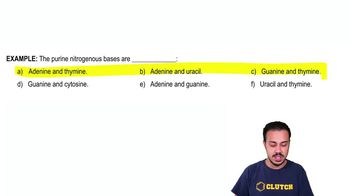
Nucleic Acids Example 2
14054
views
147
rank
04:07
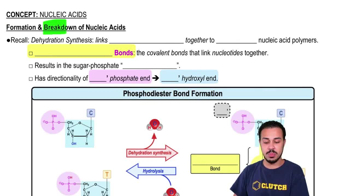
Formation & Breakdown of Nucleic Acids
16563
views
208
rank
1
comments
05:57
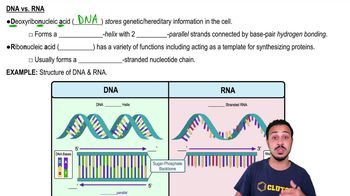
DNA vs. RNA
16680
views
196
rank
이 집합의 용어 (24)
하이드의 정의
Which best describes the role of nucleic acids?
Nucleic acids store and transmit genetic information.
What building blocks form a DNA molecule?
Nucleotides form a DNA molecule.
Are nucleosomes found in prokaryotic cells?
No, nucleosomes are not found in prokaryotic cells
Which biomolecule contains nitrogenous bases?
Nucleic acids contain nitrogenous bases.
What are the primary functions of nucleic acids in living organisms?
Nucleic acids primarily store and encode genetic information that can be passed from one generation to the next.
What are the three components of a nucleotide?
A nucleotide consists of a phosphate group, a pentose sugar, and a nitrogenous base.
What is the structural difference between deoxyribose and ribose sugars?
Deoxyribose has one less oxygen atom than ribose; deoxyribose lacks a hydroxyl group at the 2' position.
Which nitrogenous bases are classified as pyrimidines?
Cytosine, thymine, and uracil are pyrimidines.
What is the structural difference between purines and pyrimidines?
Purines have a double-ring structure, while pyrimidines have a single-ring structure.
Which nitrogenous base is found only in RNA and not in DNA?
Uracil is found only in RNA.
What is the sugar-phosphate backbone in nucleic acids?
The sugar-phosphate backbone is the repeating chain of sugars and phosphate groups that forms the structural framework of nucleic acids.
Which end of a nucleic acid strand has a free phosphate group?
The 5' end has a free phosphate group.
What type of reaction forms the phosphodiester bond between nucleotides?
A dehydration synthesis reaction forms the phosphodiester bond.
What does it mean that the two strands of DNA are antiparallel?
Antiparallel means the two DNA strands run in opposite directions, with one strand running 5' to 3' and the other 3' to 5'.
Which nitrogenous bases pair together in DNA?
Adenine pairs with thymine, and cytosine pairs with guanine.
What is the function of DNA in the cell?
DNA stores genetic or hereditary information.
What is a monomer of nucleic acids called?
A monomer of nucleic acids is called a nucleotide.
What is the significance of the 5' and 3' ends in nucleic acids?
The 5' and 3' ends determine the directionality of the nucleic acid strand, which is important for processes like replication and transcription.
How can you distinguish between a DNA and an RNA strand by looking at their nitrogenous bases?
DNA strands contain thymine, while RNA strands contain uracil instead of thymine.
What is a dehydration synthesis reaction in the context of nucleic acids?
It is a chemical reaction that joins nucleotides together by removing a water molecule, forming a phosphodiester bond.
Why are purines always paired with pyrimidines in DNA?
Pairing a purine with a pyrimidine maintains a uniform width of the DNA double helix.
What is the abbreviation for ribonucleic acid?
The abbreviation for ribonucleic acid is RNA.
What is the unique identifying feature of a pyrimidine base?
Pyrimidines have a single-ring structure.
How are the nitrogenous bases abbreviated in nucleic acid sequences?
They are abbreviated by their first letter: A for adenine, G for guanine, C for cytosine, T for thymine, and U for uracil.
 뒤로뒤로
뒤로뒤로
 01:05
01:05