Skip to main content
General Biology
나의 코스
배우기
시험 준비
AI 튜터
학습 가이드
교과서적 해결책
플래시카드
탐험해 보세요
앱을 사용해 보세요
나의 코스
배우기
시험 준비
AI 튜터
학습 가이드
교과서적 해결책
플래시카드
탐험해 보세요
앱을 사용해 보세요
뒤로
Plant Defenses exam
카드를 뒤집기 위해 탭할 수 있습니다.
Cuticle
카드를 뒤집기 위해 탭할 수 있습니다.
👆
Cuticle
A waxy layer on the surface of plant epidermis cells that acts as a physical barrier against pathogens and prevents water loss.
진행 상황 추적
컨트롤 버튼이 '내비게이션' 모드로 변경되었습니다.
1/28
관련 플래시카드
관련 실천
추천 영상
Plant Defenses quiz #1
Plant Defenses
28 용어
Plant Defenses definitions
Plant Defenses
13 용어
Plant Defenses quiz #2
Plant Defenses
12 용어
Plant Defenses
37. Plant Sensation and Response
3 문제점
주제
Jason
Tropisms and Hormones
37. Plant Sensation and Response
7 문제점
주제
Jason
37. Plant Sensation and Response
3 주제
7 문제점
장
Jason
05:37
Herbivore Defenses
2102
views
11
rank
08:59
Pathogen Defenses
1908
views
14
rank
이 집합의 용어 (28)
하이드의 정의
Cuticle
A waxy layer on the surface of plant epidermis cells that acts as a physical barrier against pathogens and prevents water loss.
What is the primary function of the cuticle in plants?
To prevent water loss and act as a physical barrier against pathogens.
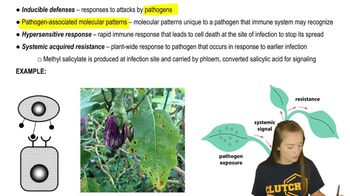
Hypersensitive Response
A rapid immune response in plants that leads to localized cell death to prevent the spread of pathogens.
What triggers the hypersensitive response in plants?
Pathogen-associated molecular patterns (PAMPs).
Systemic Acquired Resistance
A plant-wide immune response that strengthens cell walls and produces antimicrobial proteins following an initial localized infection.
How do plants signal the entire plant to activate systemic acquired resistance?
Through the production and transport of salicylic acid.
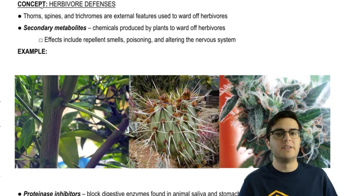
Thorns
Modified stems that act as physical defenses against herbivores.
What are protease inhibitors?
Chemicals produced by plants that block digestive enzymes in herbivores, making it difficult for them to digest plant material.
Trichomes
Hair-like structures on the surface of plants that can deter herbivores through physical and chemical means.
What role do trichomes play in plant defense?
They can physically deter herbivores and sometimes release chemicals that act as toxins.
Pathogen-associated molecular patterns (PAMPs)
Molecular patterns unique to pathogens that are recognized by the plant's immune system to trigger defense responses.
What is the role of salicylic acid in plant defense?
It acts as a signaling molecule to trigger systemic acquired resistance throughout the plant.
Secondary Metabolites
Chemical compounds produced by plants that can deter herbivores by poisoning them or altering their nervous systems.
How do plants use secondary metabolites in defense?
They produce chemicals that can poison herbivores, alter their nervous systems, or simply smell bad to deter feeding.
Systemin
A hormone that signals the production of protease inhibitors in response to herbivore damage.
What is the function of systemin in plants?
To signal the production of protease inhibitors when a plant is wounded by herbivores.
Physical Barriers
Structures like cuticles, thorns, and trichomes that physically prevent pathogen entry and herbivore feeding.
What is the purpose of the hypersensitive response in plants?
To cause localized cell death and prevent the spread of pathogens.
Chemical Deterrents
Substances like protease inhibitors and secondary metabolites that disrupt herbivore digestion or deter feeding.
How do plants use chemical deterrents against herbivores?
By producing substances that disrupt digestion or deter feeding through toxicity or bad taste.
Parasitoid Wasps
Wasps that lay their eggs inside caterpillars, leading to the larvae consuming the caterpillar from the inside out.
What is the role of parasitoid wasps in plant defense?
Plants release chemical attractants to draw parasitoid wasps, which then lay eggs in herbivorous caterpillars, killing them.
Localized Cell Death
A defense mechanism where infected plant cells undergo apoptosis to prevent pathogen spread.
What is the difference between hypersensitive response and systemic acquired resistance?
Hypersensitive response is rapid and localized, while systemic acquired resistance is slower and plant-wide.
Broad Spectrum Response
Another term for systemic acquired resistance, indicating a plant-wide defense mechanism.
What are the two main types of plant defenses against herbivores?
Physical defenses (like thorns and trichomes) and chemical defenses (like protease inhibitors and secondary metabolites).
Apoptosis
Programmed cell death, used by plants in the hypersensitive response to limit pathogen spread.
How do plants recognize pathogens?
Through pathogen-associated molecular patterns (PAMPs) that trigger immune responses.
 뒤로뒤로
뒤로뒤로
 05:37
05:37