 뒤로
뒤로Atoms and Elements - General Biology
 02:13
02:13
이 집합의 용어 (25)
An atom is the smallest unit of an element that retains the chemical properties of that element.
An element is a pure substance made of only one type of atom.
Democritus proposed that matter was made of tiny particles called atomos.
John Dalton developed the first modern atomic theory.
Protons (positive charge), neutrons (neutral), and electrons (negative charge).
Protons and neutrons are located in the nucleus of the atom.
A proton has a +1 charge and a relative mass of 1 amu.
The atomic number is the number of protons in an atom and uniquely identifies the element.
Neutrons = \(\text{mass number} - \text{atomic number}\)
Isotopes are atoms of the same element with the same number of protons but different numbers of neutrons.
Because it is a weighted average of the masses of an element's naturally occurring isotopes.
Average atomic mass = Σ(isotope mass × fractional abundance).
Periods are the horizontal rows on the periodic table, representing energy levels.
Groups or families are the vertical columns where elements have similar chemical properties.
Very reactive metals with 1 valence electron, usually forming +1 ions (e.g., Li, Na, K).
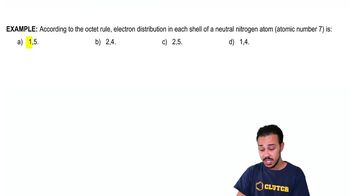
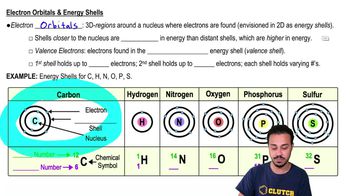
Valence electrons are electrons in the atom's outermost energy level that determine bonding and reactivity.
Elements in Group 17 have 7 valence electrons and usually form −1 ions.
Cations are positive ions formed by losing electrons; anions are negative ions formed by gaining electrons.
Ernest Rutherford discovered the atomic nucleus through the gold-foil experiment.
Each element has a unique emission spectrum, allowing identification by the specific wavelengths of light emitted when electrons fall to lower energy levels.
It releases energy as light of specific wavelengths.
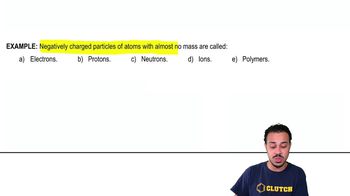
Electrons have a −1 charge and exist outside the nucleus.
Elements with properties between metals and nonmetals, such as boron, silicon, and germanium.
Metals are shiny, good conductors, malleable, ductile, and usually form positive ions.
If the number of protons (atomic number) changes, the atom becomes a different element.