 뒤로
뒤로Biological Molecules
 02:00
02:00
이 집합의 용어 (8)
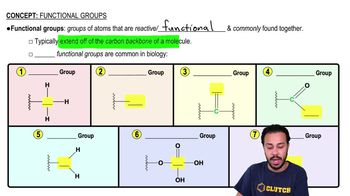
7 general functional groups
1) Hydroxyl Group (-OH)
2)Carbonyl Group (-C=O)
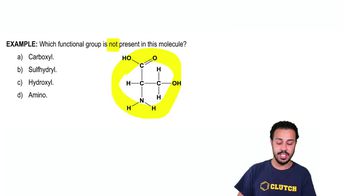
3)Carboxyl Group (-COOH)
4)Amino Groups (-NH2)
5) Sulfhydryl Groups (-SH)
6)Phosphate Groups (-PO4)
7) Methyl Groups (-CH3)
Hydroxyl Group
-OH
hydrogen atom bonded to an oxygen atom, which is bonded to a carbon skeleton
polar
in dehydration(condensation) and hydrolysis reactions
Carbonyl Group
-C=O
Carbon double bonded to and oxygen. Carbon is also bonded to a carbon skeleton is 2 possible configurations, either in the chain or at the end(terminal)
polar
If it is terminal (bonded at the end) , then the molecule is an aldehyde
If it is within the carbon skeleton, then it is a ketone.
Carboxyl Group
-COOH
Carbon is double bonded to oxygen and single bonded to the oxygen atom of the hydroxyl group.
polar
involved in peptide bonds
Amino Group
(-NH2)
2 Hydrogen are bonded to a Nitrogen, and the nitrogen is bonded to the carbon skeleton
polar
weak base
involved in peptide bonds
Sulfhydryl group
-SH
Hydrogen atom is bonded to a Sulfur which is bonded to the carbon skeleton
nonpolar
stabilizes the protein structure (strong bond)
Phosphate Group
-PO4
Phosphorus is bonded to 4 oxygen and 1 oxygen is bonded to the carbon skeleton,
polar
similar to phosphoric acid (H3PO4)
Acts as an acid since it donate protons
Links nucletides
Important in cellure energy storage and transfer
Methyl Group
3 Hydrogen bonded to a carbon atom
nonpolar
hydrophobic