Skip to main content
General Biology
나의 코스
배우기
시험 준비
AI 튜터
학습 가이드
교과서적 해결책
플래시카드
탐험해 보세요
앱을 사용해 보세요
나의 코스
배우기
시험 준비
AI 튜터
학습 가이드
교과서적 해결책
플래시카드
탐험해 보세요
앱을 사용해 보세요
뒤로
Carbon and Molecular Diversity of Life - General Biology
카드를 뒤집기 위해 탭할 수 있습니다.
Why can carbon form diverse molecules?
카드를 뒤집기 위해 탭할 수 있습니다.
👆
Why can carbon form diverse molecules?
Carbon has 4 valence electrons and forms four covalent bonds, allowing it to bond with up to four other atoms in a tetrahedral shape.
진행 상황 추적
컨트롤 버튼이 '내비게이션' 모드로 변경되었습니다.
1/20
추천 영상
03:35
Carbon is an Excellent Building Block
19772
views
727
rank
04:19
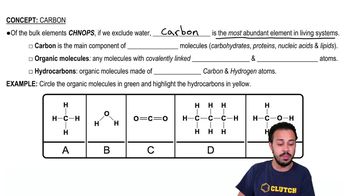
Carbon
26253
views
575
rank
2
comments
이 집합의 용어 (20)
하이드의 정의
Why can carbon form diverse molecules?
Carbon has 4 valence electrons and forms four covalent bonds, allowing it to bond with up to four other atoms in a tetrahedral shape.
What is the typical geometry of atoms bonded to carbon?
Atoms bonded to carbon are arranged in a
tetrahedral geometry
with bond angles of approximately 109.5°.
How do double bonds affect carbon molecule shape?
Double bonds between carbon atoms create
planar geometry
, restricting rotation and locking atoms in the same plane.
What are hydrocarbons?
Hydrocarbons are organic molecules made up of only
carbon and hydrogen
, often hydrophobic due to nonpolar C–H bonds.
What is the significance of hydrocarbons in biology?
Hydrocarbons form the tails of fats and store large amounts of energy through combustion reactions.
Define isomers in organic chemistry.
Isomers are compounds with the same molecular formula but different structures, leading to different chemical properties.
What are structural isomers?
Structural isomers differ in the covalent arrangement of atoms and may vary in the location of double bonds.
What are cis-trans (geometric) isomers?
Cis-trans isomers have the same covalent bonds but differ in spatial arrangement around a carbon–carbon double bond.
What are enantiomers?
Enantiomers are mirror-image isomers that occur when a carbon is bonded to four different groups, creating non-superimposable forms.
Why are enantiomers biologically important?
Typically, only one enantiomer is biologically active; the other may be inactive or have different effects.
What determines the unique properties of an organic molecule?
The arrangement of its carbon skeleton and the chemical groups attached to it determine its unique properties.
What roles do chemical groups play in organic molecules?
Chemical groups affect molecule shape, function, reactivity, and can replace hydrogen atoms in hydrocarbons.
Name the seven key functional groups in biological molecules.
Hydroxyl, Carbonyl, Carboxyl, Amino, Sulfhydryl, Phosphate, and Methyl groups.
Which functional group is hydrophobic and non-reactive?
The
methyl group
is non-reactive and hydrophobic, often serving as a recognizable tag on molecules.
What is ATP and its role in cells?
Adenosine triphosphate (ATP) is an organic phosphate that serves as the primary energy transfer molecule in cells.
How does ATP release energy?
ATP releases energy when one phosphate group is removed by reaction with water, converting it to ADP.
What is the valence and bonding capacity of carbon?
Carbon has a valence of 4, meaning it can form four covalent bonds to complete its valence shell.
How do carbon skeletons vary?
Carbon skeletons vary in length, branching, presence of double bonds, and may form rings.
What is the difference between acetone and propanal?
Acetone is a ketone with a carbonyl group within the carbon skeleton; propanal is an aldehyde with the carbonyl group at the end.
How do testosterone and estradiol differ despite similar carbon skeletons?
They differ in the chemical groups attached to their four fused carbon rings, resulting in different shapes and biological effects.
 뒤로뒤로
뒤로뒤로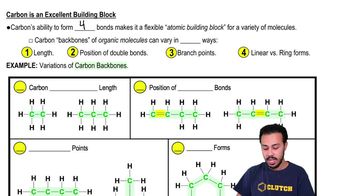
 03:35
03:35