Skip to main content
General Biology
나의 코스
배우기
시험 준비
AI 튜터
학습 가이드
교과서적 해결책
플래시카드
탐험해 보세요
앱을 사용해 보세요
나의 코스
배우기
시험 준비
AI 튜터
학습 가이드
교과서적 해결책
플래시카드
탐험해 보세요
앱을 사용해 보세요
뒤로
Cell Membranes & Cell Transport
카드를 뒤집기 위해 탭할 수 있습니다.
Plasma membrane
카드를 뒤집기 위해 탭할 수 있습니다.
👆
Plasma membrane
Separates
the inside of the cell from the outside environment;
selectively permeable
, strong, and flexible.
진행 상황 추적
컨트롤 버튼이 '내비게이션' 모드로 변경되었습니다.
1/28
추천 영상
02:21
Biological Membranes Example 1
20706
views
372
rank
1
comments
06:04
Biological Membranes
28372
views
531
rank
2
comments
이 집합의 용어 (28)
하이드의 정의
Plasma membrane
Separates
the inside of the cell from the outside environment;
selectively permeable
, strong, and flexible.
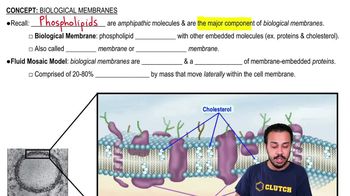
Fluid mosaic model
Membrane structure with a
phospholipid bilayer
and embedded proteins, cholesterol, and carbohydrates forming a mosaic.
Phospholipid bilayer
Composed of hydrophilic heads facing water and hydrophobic tails forming an oily middle; allows lateral movement but no flip-flop.
What molecules pass through the bilayer?
Small uncharged molecules like O2, CO2, and hydrophobic molecules such as triglycerides can pass through.
Cholesterol in membranes
Adds rigidity to animal cell membranes; inserts among fatty acid tails affecting fluidity.
Carbohydrates on membranes
Act as cell 'nametags' for immune recognition; found as glycoproteins and glycolipids.
Membrane proteins functions
Include transport, enzymatic activity, receptors, cell ID, cell joining, and signal transduction.
Integral vs peripheral proteins
Integral proteins span the membrane; peripheral proteins are often involved in signaling and attach to membrane surfaces.
Enzymatic activity of membrane proteins
Proteins act as catalysts speeding reactions, e.g., ATP synthase producing ATP in mitochondria.
Cell-to-cell recognition
Glycoproteins bind to immune cells; blood groups are examples of carbohydrate nametags.
Intercellular joining
Includes gap junctions, desmosomes, and tight junctions that connect cells physically.
Signal transduction
Membrane proteins relay external signals like hormones to the cell interior.
Diffusion
Movement of molecules from higher to lower concentration; faster for gases, small molecules, and heated molecules.
Passive diffusion
Molecules move down concentration gradient without energy; small neutral or hydrophobic molecules pass this way.
Facilitated diffusion
Passive transport using proteins to help polar or charged molecules cross membranes.
Osmosis
Passive movement of free water across membranes; water moves opposite to solute concentration.
Aquaporins
Channel proteins that facilitate rapid water transport across membranes without energy use.
Tonicity
Ability of a solution to cause a cell to gain or lose water; related to solute concentration differences.
Hypotonic solution
Has less solute than the cell; water moves into the cell causing it to swell or burst.
Hypertonic solution
Has more solute than the cell; water moves out causing the cell to shrink.
Isotonic solution
Has equal solute concentration as the cell; no net water movement occurs.
Active transport
Moves molecules against concentration gradient using carrier proteins and energy, usually ATP.
Types of active transport pumps
Uniport (one substance), symport (two substances same direction), antiport (two substances opposite directions).
Na+/K+ pump
Primary active antiport pump moving 3 Na+ out and 2 K+ in per ATP hydrolyzed; essential in animal cells.
Secondary active transport (cotransport)
Uses energy from one solute moving down its gradient to move another solute against its gradient.
Vesicular transport
Bulk transport of large molecules via endocytosis (phagocytosis, pinocytosis) and exocytosis.
Endocytosis
Membrane engulfs particles or fluids forming vesicles to bring materials into the cell.
Exocytosis
Vesicles fuse with plasma membrane to release contents outside the cell.
 뒤로뒤로
뒤로뒤로
 02:21
02:21