 뒤로
뒤로Cellular Respiration and Energy Transfer in General Biology
 01:44
01:44
이 집합의 용어 (20)
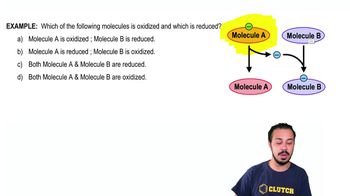
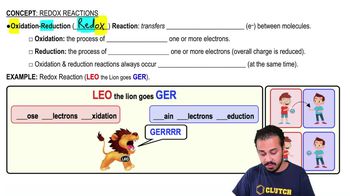
Oxidation is the loss of electrons, and reduction is the gain of electrons during chemical reactions.
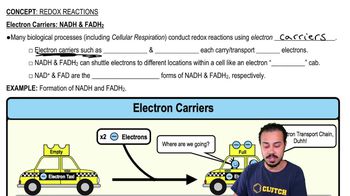
NAD+ and FAD act as electron carriers, accepting electrons during oxidation of organic fuels to transfer energy.
Glucose and oxygen are converted into carbon dioxide, water, and energy: \(\mathrm{C_6H_{12}O_6 + 6O_2 \rightarrow 6CO_2 + 6H_2O + energy}\).
To convert chemical energy in glucose into usable energy in the form of ATP for cellular activities.
Glycolysis occurs in the cytoplasm and does not require oxygen (anaerobic process).
Substrate: glucose; Products: 2 pyruvate, 2 ATP (net), and 2 NADH molecules.
Energy investment uses ATP to phosphorylate glucose; energy payoff produces ATP and NADH by substrate-level phosphorylation.
Pyruvate is converted to acetyl CoA, producing NADH and releasing CO2; occurs in the mitochondrial matrix.
No, but it requires aerobic conditions because it is linked to the electron transport chain which needs oxygen.
Substrate: acetyl CoA; Products per cycle: 3 NADH, 1 FADH2, 1 ATP, and 2 CO2 molecules.
In the mitochondrial matrix.
Process where energy from the electron transport chain is used to power ATP synthesis via chemiosmosis.
ETC transfers electrons from NADH and FADH2 to oxygen, releasing energy used to pump protons and create a gradient.
Movement of protons down their gradient through ATP synthase to produce ATP.
Approximately 3 ATP per NADH and 2 ATP per FADH2.
During glycolysis and the citric acid cycle, directly producing ATP without the electron transport chain.
About 30-32 ATP molecules per glucose.
To regenerate NAD+ from NADH allowing glycolysis to continue when oxygen is absent.
In alcohol fermentation, acetaldehyde accepts electrons; in lactic acid fermentation, pyruvate accepts electrons.
It is a key enzyme in glycolysis regulated by feedback inhibition to control the rate of respiration based on cellular energy needs.