 뒤로
뒤로Cellular Respiration & Fermentation
 01:53
01:53
이 집합의 용어 (20)
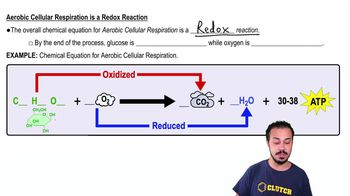
Glucose plus oxygen produces carbon dioxide, water, and energy: \(C_6H_{12}O_6 + 6 O_2 \rightarrow 6 CO_2 + 6 H_2O + Energy\).
Redox reactions involve the transfer of electrons where one molecule is oxidized (loses electrons) and another is reduced (gains electrons).
NAD+ acts as a coenzyme that accepts electrons and hydrogen ions to become NADH, temporarily storing energy.
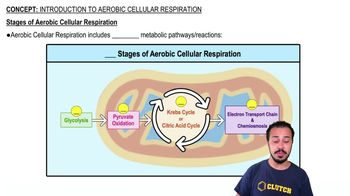
Glycolysis occurs in the cytoplasm and produces 2 pyruvate, 2 ATP (net), and 2 NADH molecules.
Pyruvate is converted to Acetyl CoA by removing CO2, producing NADH, and attaching Coenzyme A.
It occurs in the mitochondrial matrix and produces CO2, ATP, NADH, and FADH2.
The ETC transfers electrons from NADH and FADH2 through proteins, pumping protons to create a gradient for ATP synthesis.
ATP is produced by ATP synthase as protons flow back into the mitochondrial matrix through chemiosmosis.
It is the process where H+ ions flow down their concentration gradient through ATP synthase to generate ATP.
Approximately 36-38 ATP molecules are produced per glucose molecule.
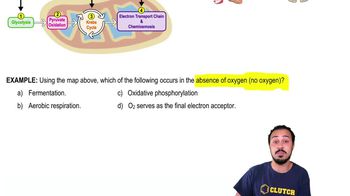
Fermentation is an anaerobic process that regenerates NAD+ allowing glycolysis to continue when oxygen is absent.
Alcohol fermentation produces ethanol and CO2; lactic acid fermentation produces lactate.
Pyruvate is converted to acetaldehyde (releasing CO2), then reduced to ethanol, regenerating NAD+.
Pyruvate accepts electrons from NADH to form lactate, regenerating NAD+.
Aerobic respiration yields 36-38 ATP per glucose; fermentation yields only 2 ATP per glucose.
Fats are broken down into glycerol (enters glycolysis) and fatty acids (converted to Acetyl CoA).
Proteins are broken down into amino acids, which enter glycolysis, Acetyl CoA formation, or the citric acid cycle.
It houses the electron transport chain and ATP synthase, essential for oxidative phosphorylation.
Oxygen acts as the final electron acceptor in the ETC, combining with electrons and protons to form water.
Energy investment uses 2 ATP to start glycolysis; payoff phase produces 4 ATP and 2 NADH, netting 2 ATP.