 뒤로
뒤로Ch 6-10 exam prep
 06:35
06:35
이 집합의 용어 (146)
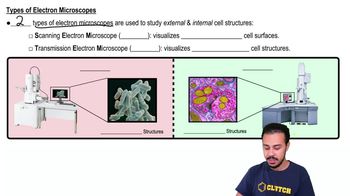
What kind of microscope looks at the outside of cells? What kind looks at insides of cells?
Scanning Electron Microscope (SEM)
Translating Electron Microscope (TEM)
What does Pro and Eu stand for in prokaryotic and eukaryotic? What does the suffix karyote mean?
Pro means first or before and Eu means good in terms of has.
Karyote referrs to neucleus.
What kind of ribosomes do proK and euK cells have? What does it refer to?
ProK cells have 70S ribosomes, and euK have 80S ribosomes.
The size.
Which cells are multicellular?
Eukaryotic cells. Also probably fungi cells and maybe some others I don't know yet.
Describe a ProK cell. Describe a EuK cell
A cell 1 micrometer or so long with no membrane bound organelles, 70S ribosomes, Circular DNA not bound by a nucleus, therefore in a nucleoid.
A cell around 100 micro meters long with membrane bound organelles, 70S ribos, linear DNA in a nucleus.
What is an organelle?
A part of a cell that performs a specific function for the life of the cell. (revise)
What domain do plants and animals belong to?
Eukaryotic.
Which organelles are shared by both plants and animals (generally)?
Mitchondria, Golgi apparatus, Rough and Smooth ER (endoplasmic reticulum), ribosomes, cell membranes, peroxisomes
What organelles are only found in animals?
Lysosomes
What organelles are only found in plants?
Chloroplast.
What is a ribosome and what do they do? What makes them different from other organelles? What are two options for ribosomes?
A ribosome is a non-membranous organelle that uses a process called Translation to build proteins from genetic material (mRNA). They can be free floating in the cytoplasm or attached to other organelles like endoplasmic reticulum
What is the endomembrane system? Which two functions do we focus on regarding the endomembrane system? What does endo- mean?
A group of membrane-bound organelles inside a euK cell. The organelles are bound by vesicles (little membrane bubbles).
Protein secretion and Cellular digestion.
Inside!
List some organelles in the endomembrane system?
Nuclear envelope, Endoplasmic reticulum, Golgi apparatus, transport vesicles.
Lysosomes & peroxisomes, vacuoles, and cell membrane.
What is protein secretion?
A process involving several different organelles in a specific order where proteins are released into the environment.
What is a nucleus? What are it's parts?
A rounded protective surface that holds most of a euK cells DNA
Nuclear envelope is the double membrane separates the inside and outside of the nucleus. Nuclear pores are tiny holes that allow entry and exit in and out of the nucleus. Nucleolus is the small dense structure where ribosomes are made.
What is the endoplasmic reticulum? What's its lumen?
They are membranous structures that are continuous with the cells nuclear envelope.
ER Lumen refers to the internal space of the ER.
What is a rough ER? What is a smooth ER?
Rough ER is the side closest to the nucleus where there are lots of ribosomes attached to it. Newly built proteins are folded and modified in the rER.
Smooth ER is the outer layer of ER with no ribosomes. The sER is associated with forming lipids and detoxifying drugs/poisons, Ca ion storage.
What is a vesicle?
A transport molecule that takes proteins and lipids from the nucleus to the Golgi apparatus.
What is the Golgi apparatus? What does it do?
A stack of cisternae (flat membranous sacs). (cristae?)
It functions as a processing center, receiving vesicles (kinda like packages), repurpose or modify, then repackage and send vesicles for export.
What are the ends of the Golgi apparatus called? What does it do with the cell membrane?
The cis end of the Golgi receives vesicles to be processed, the trans end exports vesicles.
Sometimes they (vesicles) are fused with cell membranes for the purpose of secretion.
In the endomembrane system, which two organelles are digestive in function?
Lysosomes and Peroxisomes.
What is a lysosome?
Lysosomes are fused to vesicles that are acidic in nature and they carry digestive (hydrolytic) enzymes that break down many things. They can recycle food, debris, bacteria, etc. Lysosomes are only found in animal cells and originate from the golgi apparatus.
What is a peroxisome?
A peroxisome is a vesicle that carries a digestive enzyme that breaks down toxins like H2O2, it also breaks down fatty acids. Peroxisomes are found in all euK cells, plants and animals alike, and originate from the rough ER.
What is a central vacuole? What cells is it found in?
Central vacuoles are large membrane enclosed vesicles. Central vacuoles have several diverse functions but primarily degrade and recycle molecules. It can also fill with water to exert turgor pressure on the cell wall to inflate the cell.
What are mitochondria? What important process does it perform? What makes this organelle different than most others?
Organelles that synthesis energy for the cell. ATP or adenosine triphosphate is made here.
Cellular respiration is the process of converting sugars and lipids to make ATP.
Mitochondria have their own independent DNA.
List the elements of mitochondrial structure. What is in the mitochondrial matrix?
Outer membrane, Inner membrane that includes cistae (folds), intermembrane (the space between outer and inner).
The matrix is inside the inner membrane and contains mitochondrial DNA, ribosomes, enzymes
What are chloroplasts? What is photosynthesis?
Chloroplasts are green organelles that function as the site of the function photosynthesis.
A cellular process that uses sunlight to synthesize sugars (glucose). It converts CO2 and water and sunlight into glucose and oxygen gas.
Describe the structure of a chloroplast.
Chloroplasts have inner and outer membranes (no cristae (folds)), Thylakoids (disc shaped structures) hollow interconnected sacs, Grana/granum (stacks of thylakoids), Stroma (the innermost region where enzymes, ribosomes, and chloroplast DNA live).
What is endosymbiotic theory?
The theory that chloroplasts and mitochondria were once independently living cells 1.5bya. An aerobic cell (uses oxygen in its metabolism) was engulfed by an anaerobic cell and began a symbiotic relationship.
What is some of the supporting evidence for endosymbiotic theory?
There are similarities between proK cells and mitochondria and chloroplasts including, sharking 70S ribosomes, small circular DNA, and replication by binariy fission. Mito' and Chloro' also have two membranes, inner and outer, which is consistent with the idea of engulfment.
What is the cytoskeleton? What does it do?
A network of elongated protein structures within the cytoplasm with multiple functions.
Some functions include, providing shape, structure, movement, and can also be involved with transporting molecules within the cells, it can also be involved in biosignaling.
What are the three major components of the cytoskeleton? What do they do?
Microfilaments are small rods that are usually made of thin rods of repeating actin proteins.
Intermediate filaments vary in size and can be made of variable proteins
Microtubules are the largest in size and form cylindrical tubes made of tubulin proteins.
What are cilia and flagella?
Both are primarily made from microtubules and provide movement for the cell or to move objects (in the case of cilia). Cilia are lots of short hair like structures that move like oars. Flagella are long tail like structures that move like whips.
What are the four types of cell junctions?
Tight, membrane proteins that form leakproof barriers between linked cells.
Anchoring junctions (desmosomes) intermediate filiaments that anchor cells together.
Gap, protein channels that connect the two cytoplasms between cells.
Plasmodesmata, gaps in plant cell walls. (similar to gap junctions)
What is a cytosol?
The semifluid portion of the cytoplasm (the interior of the cell).
What are microvilli?
Long and thin projections from the surface of the cell, used to increase surface area of the cell without a porportional increase to cell volume.
ex intestinal lining cells using more surface area to absorb materials.
What is nuclear lamina?
The netlike structure that lines the inner surface of the nuclear envelope. It is part of the pore complex in the nucleus.
What are chromosomes?
What is chromatin?
Discrete units of DNA contained in one long molecule associated with many proteins, including histones.
The complex of DNA and proteins making up chromosomes.
How many chromosomes do humans have?
Fruit flies?
46 in each cell, 23 in sex cells
8 in each cell, 4 in sex cells
What is rRNA?
What does it do?
Ribosomal RNA
Provides instructions to make large and small subunits of ribosomes, to be fully assembled in the cytoplasm
What are glycoproteins?
Proteins with carbohydrates covalently bonded to them. They can be found as secretory proteins.
What is the cisternal maturation model for Golgi apperatus?
The idea that the cisternae or the "stacks" of the Golgi apparatus membranes progress forward from cis (flat, ER facing) to trans (porous opposing side) face and modify their cargo as they move.
What is phagocytosis?
The process by which unicellular protists engulf smaller organisms or food particles. A food vacuole is formed inside the protist, where it is then fused with lysosomes whose enzymes digest the food.
What is a macrophage?
A type of white blood cell that helps to defend the body by engulfing and destroying bacteria and other invaders.
What is autophagy?
A process by which a cells organic material is broken down by a lysosome.
What is a vacuole?
A large vesicle derived from endoplasmic reticulum or Golgi apparatus. The vacuolar membrane is selective in transporting solutes; as a result, the solution inside a vacuole differs in composition from the cytosol.
What is cell motility?
Cell motility includes both the changes in cell location and movements of cell parts. Cell motility generally requires interaction of the cytoskeleton with motor proteins.
What is a motor protein?
A protein that interacts with cytoskeletal elements and other cell components, producing movement of the whole cell or parts of the cell.
What is a centrosome?
A structure present in the cytoplasm of animal cells that functions as a microtubule-organizing center and is important during cell division. A centrosome has two centrioles.
What are dyneins?
Motor proteins found in cilia and flagella also sometimes used in transporting along cytoskeletal pathways.
What is a cortex?
The outer cytoplasmic layer of a cell.
What is myosin?
A cytoskeletal filament protein used to cause contraction of muscle cells. Used as the opposing force of actin filaments in contractions.
What are pseudopodia?
"False feet." Cellular extensions that extend out and then move towards the cell to crawl along a surface.
What is cytoplasmic streaming? What protein is responsible for it?
A circular flow of cytoplasm within plant cells. Allows for more movement of organelles and the distribution of materials within the cell.
Actin proteins.
What are intermediate filaments?
Keratin or other intermediately sized proteins usually found in vertebrates that act as a more permanent structure for cells.
What is an extracellular matrix? (ECM)
Glycoproteins like collagen, fibronectin, and other carbohydrate-containing molecules secreted by the cells that form a layer around the plasma membrane. Integrins are proteins within the plasma membrane that bind the ECM to the cells.
What are proteoglycans?
A proteoglycan molecule consists of a small core protein with many carbohydrate chains covalently attached, so that it may be up to 95% carbohydrate. A network of collagen fibers and other proteins that are secreted by cells.
What is epithilial tissue?
Cells that line the inside and outside surfaces of the body.
What are active transport, passive transport and bulk transport?
Active transport of small molecules that requires energy and a transport protein.
Passive transport through the plasma membrane doesn't require energy and usually works for small molecules. It may involve transport proteins.
Bulk transport moves larger molecules.
What are exocytosis and endocytosis?
Exocytosis is when large molecules are secreted when a vesicle fuses with the plasma membrane. exo, exit
Endocytosis is when large molecules are taken in when the plasma membrane pinches inward, forming a vesicle. endo, enter
What does the term amphipathic mean?
A molecule that has both a hydrophilic region and a hydrophobic region. Typically refers to phospholipids and membrane proteins.
What is a fluid mosaic model?
The currently accepted model of cell membrane structure, which envisions the membrane as a mosaic of protein molecules drifting laterally in a fluid bilayer of phospholipids.
How do unsaturated and saturated hydrocarbon tails in membrane bilayer lipids display differently?
Unsaturated fats in bilayers have hydrocarbon tails that are kinked, which prevents packing, which enhances membrane fluidity.
Saturated fats in bilayers have hydrocarbon tails are straight and pack together more tightly, increasing membrane viscosity.
Describe the effects of cholesterol on membrane fluidity in animals.
Cholesterol can be thought of as a "fluidity buffer" for membranes. It resists changes in fluidity that can be caused by changes in temperature. At high temperatures, it makes membranes less fluid by restraining phospholipid movement. At low temps it hinders the close packing of lipids.
What are integral, transmembrane, and peripheral proteins?
Integral proteins penetrate the hydrophobic interior of the lipid bilayer.
The majority of integral proteins are transmembrane proteins, which span the membrane.
Peripheral proteins are not embedded in the lipid bilayer but are loosely bound to integral proteins or the surface of the membrane
What are integrins?
Integral, transmembrane proteins that are attached to fibers of the extracellular matrix.
What are the six major functions of membrane proteins?
Transport, Enzymatic activity, Signal transduction, cell-cell recognition, intercellular joining, Attachment from cytoskeleton to extracellular matrix.
Which part of the phospholipid varies and leads to the different types of human blood (A, B, AB, and O)?
These are variations on the carbohydrate part of glycoproteins on the surface of red blood cells.
What are channel proteins?
Transport proteins that function by having a hydrophilic channel that certain molecules or ions use as a tunnel through the membrane.
Aquaporins are an example of proteins that channel the passage of water molecules.
What is diffusion? What is a concentration gradient?
The movement of particles of any substance so that they spread out into the available space.
A region along which the density of a chemical substance increases or decreases. Concentration gradient represents potential energy.
What is osmosis?
The diffusion of free water across a selectively permeable membrane.
What is tonicity? What is isotonic?
The ability of a surrounding solution to cause a cell to gain or lose water. The tonicity of a solution depends on its concentration of solutes that cannot cross the membrane relative to that inside the cell.
Isotonic refers to an environment where there will be no net movement of water in the cell.
What happens to animal cells in a hypotonic, isotonic, and hypertonic solution? (Typical, non-specially adapted case)
In hypotonic solutions, the cell can become Lysed (burst), meaning it gains too much water.
In isotonic solutions the cell is normal.
In hypertonic solutions, the cell becomes shriveled.
What happens to plant cells in hypotonic, isotonic, and hypertonic solutions?
In hypotonic solutions, the plant cell becomes turgid (normal)
In isotonic solutions, the cell becomes flaccid.
In hypertonic solutions, the cell becomes plasmolyzed, where the plant cell shrivels and its plasma membrane pulls away from the cell wall in multiple places.
Explain why an increase in the salinity of a lake can kill the animals in it.
As the salinity of the lake increases, so does it's hypertonicity of water. This increase in solute in the environment causes osmosis to diffuse water away from the direction of the animal or plant cells, causing them to become shriveled or plasmolyzed.
What is osmoregulation?
The control of solute concentrations and water balance in an organism.
What is facilitated diffusion?
The passage of molecules or ions down their electrochemical gradient across a biological membrane with the assistance of specific transmembrane transport proteins, requiring no energy expenditure. This doesn't alter the direction of transport.
What are ion channels and gated channels?
Ion channels are channel proteins that transport ions, Many ion channels function as gated channels, which open or close in response to a stimulus. Sometimes the stimulus is electrical (nerve cells), sometimes the stimulus is chemical.
What supplies the energy for most active transport proteins? List an example
ATP hydrolysis.
One transport system that works this way is called the sodium-potassium pump, which exchanges Na+ for K+ across the plasma membrane of animal cells. Na+ binds to the protein with high affinity. The protein changes shape and Na+ are secreted. The new shape allows K+ to bond.
What is voltage? What does it have to do with plasma membranes?
Voltage is electrical potential energy, or a separation of opposite charges.
The voltage across a membrane, membrane potential, ranges from -50 to -200 millivolts. This is due to unequal distribution of anions and cations on the two sides. The inside is negative, the outside is positive-relatively
Generally what two forces drive the diffusion of ions across the membrane? Describe them.
What is the combination of these called?
A chemical force, the ion's concentration gradient, where the membrane potential favors transport of cations into the cell and anions out of the cell.
An electrical force, the effect of the membrane potential on the ion's movement.
These forces are called the Electrochemical gradient.
What is an electrogenic pump? List some examples
An active transport protein that generates voltage across a membrane by the transport of anions and cations. By generating voltage across membranes, pumps help store energy that can be tapped for cellular work. A sodium-potassium pump, or a proton pump.
Describe a cotransport and what it does. List an example in plants
A transport protein (cotransporter). It works by coupling of the “downhill” diffusion of one substance to the “uphill” transport of another against its own concentration gradient.
H+/sucrose cotransport proteins in tandem with proton pumps can diffuse sucrose into the cell against its gradient.
List examples of exocytosis.
In pancreas cells, insulin is created and secreted into extracellular fluid by exocytosis.
In nerve cells, neurotransmitters (signalers) are secreted by exocytosis.
Plant cell walls are created by exocytosis delivering proteins and carbohydrates.
What are the three types of endocytosis?
Phagocytosis, or cellular eating, where pseudopodia engulf material
pinocytosis, or cellular drinking, where the membrane collapses around material,
receptor-mediated endocytosis, a specialized type of pinocytosis where receptors manage the engulfed material.
Define metabolism. What is a metabolic pathway?
A metabolism is the totality of an organisms chemical reactions.
A metabolic pathway follows a specific molecule that is altered in a series of defined steps, resulting in a certain product. Each step is catalyzed by a specific enzyme, a macromolecule that speeds up a chemical reaction.
What are the two metabolic pathways and what do they do?
Catabolic (breakdown) pathways, break down complex molecules into simpler compounds to release energy. ex. cellular respiration.
Anabolic (biosynthetic) pathways, consume energy to build complicated molecules from simpler ones. ex. amino acid and protein synthesis.
Define bioenergetics and chemical energy.
Bioenergetics is the study of how energy flows through living organisms.
Chemical energy is used to refer to the potential energy available for release in a chemical reaction.
Define thermodynamics.
Define the following terms used in its study.
Thermodynamics is the study of energy transformations that occur in a collection of matter.
System denotes the matter under study, everything outside the system is denoted as surroundings. An isolated system, like water in a thermos bottle, is closed, and an open system transfers energy around.
What are the first two laws of thermodynamics?
The principle of conservation of energy. Energy cannot be created or destroyed, only transferred or transformed.
Every energy transfer or transformation increases the entropy (disorder) of the universe.
Define a spontaneous process in the context of thermodynamics.
A process that occurs without an overall input of energy; a process that is energetically favorable.
What is the Gibbs free energy function?
Delta G = Delta H - T Delta S
or
Change in free energy is equal to the change in the system's enthalpy (total energy) minus the absolute temperature times the change in the systems entropy.
Negative Delta G values are spontaneous. Positive and negative Delta G values are never spontaneous.
What is equilibrium, how does it effect spontaneous work?
Equilibrium is a state of maximum stability. A process is spontaneous and can perform work only when it is moving toward equilibrium.
What is an exergonic reaction? What is an endergonic reaction?
A reaction of chemicals that releases energy from potential energy in products. It has a negative Delta G or free energy. "an exit or production of energy"
A reaction of chemicals that consumes energy to make products. It has a positive Delta G or free energy. "an entrance or storing of energy."
What three main types of work does a cell do?
Chemical work, the pushing of endergonic reactions that would not occur spontaneously, like synthesizing polymers.
Transport work, the pumping of substances across membranes against the direction of spontaneous movement.
Mechanical work, such as the contraction of muscle cells.
What is energy coupling?
The use of an exergonic process to drive an endergonic one.
What is ATP and what is its main use? What kind of reaction does it produce? And how much kcal of energy is released?
Adenosine triphosphate when hydrolyzed releases energy and produces inorganic phosphate and adenosine diphosphate.
ATP produces an exergonic reaction when hydrolyzed.
7.3 kcal of energy
Describe energy coupling with glutamic acid and ATP
Glutamic acid is phosphorylated by hydrolysis of ATP, resulting in a phosphorylated intermediate and ADP, then ammonia spontaneously displaces the phosphate group resulting in glutamine (glutamic acid and ammonia), ADP, and an inorganic phosphate.
Describe a case of ATP performing mechanical work
ATP binds noncovalently to motor proteins and then is hydrolyzed, causing a shape change that walks the motor protein forward along a cytoskeleton.
What is activation energy? How is it abbreviated?
The energy required to contort the reactant molecules so the bonds can break. It can be thought of as the amount of energy needed to pus hthe reactants to the top of an uphill energy barrier so that the downhill part of the reaction can begin. Often supplied by heat.
E_A
What is the transition state?
When molecules have absorbed enough energy for the bonds to break, the reactants are in an unstable condition.
What is an enzyme's substrate? What is formed when they are bound? Where do they bond and how does the enzyme react? What suffix do they end in?
The reactant that an enzyme acts on.
Enzyme-substrate complex.
Active site, the enzyme can tighten after initial contact, called induced fit.
-ase (amylase, sucrase)
What are cofactors? What is a coenzyme?
Nonprotein helper molecules for catalytic activity often for chemical processes like electron transfers. Some cofactors are inorganic, such as zinc, iron and copper in ionic form.
If the cofactor is an organic molecule, it's referred to as a coenzyme.
What are competitive inhibitors? What are non-competitive inhibitors?
Look alike molecules that bind to enzymes (usually reversibly) to inhibit the productivity of those enzymes by blocking substrates from entering active sites.
Molecules that distort the shape of enzymes to warp the active site, such that it is no longer effective.
What is allosteric regulation of enzymes?
Any case in which a protein's function at one site is affected by the binding of a regulatory molecule to a separate site. It may result in either inhibition or stimulation of enzymatic activity.
What is feedback inhibition?
A metabolic pathway that is halted by the inhibitory binding of its end product to an enzyme that acts early in the pathway.
What is fermentation?
A partial degradation of sugars or other organic fuel that occurs without the use of oxygen.
What is aerobic (cellular) respiration? What is anaerobic respiration?
Aerobic respiration is the most efficient catabolic pathway, where oxygen is consumed as a reactant along with organic fuel. Most cells can carry out aerobic respiration.
Some prokaryotes use substances other than oxygen as reactants, this process is anaerobic respiration.
Is the breakdown of glucose exergonic or endergonic?
Exergonic, meaning the reaction can take place without the input of energy (spontaneously)
What are oxidation-reduction reactions?
Redox reactions for short are the loss of electrons from one substance and adding electrons to another substance. In this case the substance losing electrons is being oxidized and the addition of electrons to a substance is being reduced (because it reduces the positive charge).
What is a reducing agent and what is an oxidizing agent?
The reducing agent is the electron donor (+) in a redox reaction, and the oxidizing agent is the electron acceptor (-).
The oxidizing agent becomes reduced and the reducing agent becomes oxidized. Really dumb nomenclature.
What is NAD+ and NADH? What important function does it perform?
Nicotinamide adenine dinucleotide, derived from the vitamin niacin. It is a coenzyme that cycles between its oxidized form, NAD+ and its reduced form, NADH. NAD+ functions as an oxidizing agent during respiration.
What is an electron transport chain?
A number of molecules, mostly proteins, built into the inner membrane of the mitochondria of eukaryotic cells. Electrons removed from glucose are shuttled by NADH down to the O2 molecules where they from water.
This controlled release is used to synthesize ATP.
What are the three stages of cellular respiration?
Glycolysis, pyruvate oxidation and citric acid cycle, and oxidative phosphorylation.
What is glycolysis and where does it occur? (In cellular respiration)
Glycolysis breaks glucose into two molecules of pyruvate to enter the mitochondria of the cell and produce ATP. It occurs in the cytosol. Glycolysis means sugar splitting.
What is the citric acid cycle?
Pyruvate inside the mitochondria that is oxidized to a compound called acetyl (coenzyme A) CoA both enter the citric acid cycle. Pyruvate is broken down into carbon dioxide during this cycle.
What is oxidative phosphorylation?
The mode of synthesis of ATP where it is powered by the redox reactions of the electron transport chain. It makes up almost 90% of ATP production generated by respiration. (Attaching loose phosphates)
What is substrate-level phosphorylation?
ATP synthesis where enzymes transfer a phosphate group from a substrate molecule (an organic molecule generated as an intermediate during catabolism of glucose) directly to ADP, instead of adding inorganic phosphate groups to ADP. (Transferring phosphates)
What are cytochromes? What are prosthetic groups?
Cytochromes are proteins that are electron carriers. Prosthetic groups are molecules attached to proteins, sometimes they are cofactors or they can be enzymes or probably other proteins or something.
What is chemiosmosis?
Chemiosmosis is the second part of ATP development in the oxidative phosphorylation process. The electron transport chain builds a H+ gradient on the intermembrane space, which provides the energy by diffusion to power ATP synthase.
What is ATP synthase?
The enzyme that makes ATP from ADP and inorganic phosphate. It propels a rotor attached to the inner membrane of mitochondria by using free hydrogen+ molecules. This rotor moves its multisubunit complex that catalyzes ATP production from ADP and inorganic phosphate. smallest molecular rotary motor
What is proton-motive force?
The potential energy utilized by creating a proton gradient across a membrane where diffusion is used to perform work.
Describe alcohol fermentation.
Pyruvate is converted to ethanol in two steps, first by releasing CO2 and creating acetaldehyde, then by being reduced by NADH. This process regenerates NAD+ for the continuation of glycolysis.
Describe lactic acid fermentation.
Glycolysis breaks down glucose into two pyruvate, producing 2 NADH, then those pyruvate are converted into two lactate (a molecule similar, but with more hydrogen atoms). This second step regenerates NAD+ from NADH. There is no CO2 release in lactic acid fermentation.
What are abligate anaerobes and facultative anaerobes?
Obligate anaerobes carry out only fermentation or anaerobic respiration. They also cannot survive the presence of oxygen.
Facultative anaerobes can use either fermentation or respiration.
What is beta oxidation?
Beta oxidation breaks fatty acids down to two-carbon fragments which enter the citric acid cycle as acetyl CoA. Beta oxidation also recycles NADH and FADH2
What are the inputs and outputs of glycolysis
IN: glucose, NAD+, ADP + phosphate
OUT: pyruvate, NADH, ATP
What are the inputs and outputs of Acetyl CoA formation and the citric acid cycle?
IN: pyruvate, NAD+, ADP + phosphate
OUT: CO2, NADH, ATP
What are the inputs and outputs of oxidative phosphorylation?
IN: O2, NADH, ADP + phosphate
OUT: water, NAD+, ATP
What is photosynthesis? What are autotrophs? What are heterotrophs?
Photosynthesis is the process that transforms energy from sunlight into chemical energy in sugars and other organic molecules.
Autotrophs are "self-feeders"
Organisms unable to make their own food.
What are the parts of a leaf? Describe them.
Mesophyll cells have the most chloroplasts and are found on the tissues in the interior of the leaf.
Chloroplasts are organelles that perform photosynthesis.
Veins,
Stomata, the microscopic pores that CO2 enters and O2 exits.
What are the parts of the chloroplast?
Outer and inner membranes, with an intermembrane in between.
Thylakoids that have space inside called thylakoid space.
Granum, which is a stack of thylakoids.
Stroma, the inner dense fluid.
What are the two phases of photosynthesis? Breifly summarize them
Light reactions inputs are Light, H2O, NADP+, ADP+ inorganic phosphate, and out are ATP, NADPH, and O2, these happen in the thylakoid. Light is converted to chemical energy.
Calvin cycle reactions inputs are ATP, NADPH, CO2, and outputs are CH2O these happen in the stroma. Calvin cycle makes sugars.
What are NADP + and NADPH? What process are they used in.
NADP+ (nicotinamide adenine dinucleotide phosphate) temporarily stores electrons and hydrogen ions from water.
NADPH the reduced form of NADP+
Photophosphorylation is the worst word of all time and the process of using chemiosis to make ATP
What is carbon fixation?
The initial incorporation of carbon from carbon dioxide into an organic compound by an autotrophic organism (a plant, another photosynthetic organism, or a chemoautotrophic prokaryote).
What is a spectrophotometer and what graph does it make?
A machine that can measure the ability of a pigment to absorb various wavelengths of light. A graph plotting a pigment's light absorption versus wavelength is called an absorption spectrum.
What are chlorophyll a and chlorophyll b? What are carotenoids?
Chlorophyll a is the key light-capturing pigment that participates directly in the light reactions.
Chlorophyll b are accessory pigments.
a and b are usually absorbing violet-blue and red light.
Carotenoids are accessory (protective) pigments as well, usually absorbing just violet-blue light.
What is an action spectrum?
A graph that plots the rate of photosynthesis versus wavelength.
What is a photosystem? Where is it located?
A photosystem is composed of a reaction-center complex surrounded by several light-harvesting complexes.
It's located in the thylakoid membrane that separates the thylakoid space and the stroma.
What are the parts of a photosystem?
Light-harvesting complexes consist of various pigment molecules (like chlorophyll) bound to proteins.
Reaction-center complex is an organized association of proteins and a primary e- acceptor.
Pigment molecules which are activated by light to produce chemical energy.
Primary electron acceptor
What is a primary electron acceptor
A molecule that is able to be reduced or is capable of accepting electrons.
What are photosystem 2 and photosystem 1?
The two photosystems responsible for producing energy. They work in tandem via electron transport chain to produce ATP, NADPH.
PS2 is first, and takes light, water (which is split to give electrons to chlorophyll) and makes ATP with ETC
PS1 gets more energy from PS1, light and passes e- to NADPH
198
What is linear electron flow?
The flow of electrons through the photosystem and other molecular components built into the thylakoid membrane.
What is cyclic electron flow?
A short circuit where an electron recycles itself in PS1, where instead of the Primary Electron Acceptor making NADPH through NADP+ reductase, it instead makes ATP through the cytochrome complex.
What sugar is made from the calvin cycle, how many carbons does it have, how many cycles need to take place before one is made?
Glyceraldehyde 3-phosphate.
Three carbons.
Three cycles, one per carbon atom.
What are the three faces of the calvin cycle?
Carbon fixation turns a 5 carbon sugar and rubisco enzyme into a 6 carbon sugar that breaks into 3 carbon sugars and uses ATP
Reduction, from NADPH turns this into G3P (usable sugar)
Regeneration of CO2 acceptor, 5 of 6 G3P are used with ATP to regenerate RuBP, the 5 carbon sugar at the beginning.