 뒤로
뒤로Ch12 - 16 exam prep
 04:45
04:45
이 집합의 용어 (38)
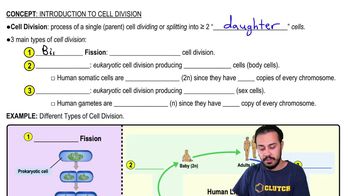
What is cell division?
The reproduction of cells.
What is a genome?
A cells genetic information.
What are chromosomes? What is a chromatin?
One very long linear DNA molecule associated with many proteins.
Chromatin is the entire complex of DNA and the proteins that are the building material of chromosomes.
These vary in their degree of condensation during the process of cell division.
What are somatic cells? What are Gametes? How do they differ in terms of how many chromosomes they have?
Somatic cells are all body cells except for the reproductive cells.
Gametes are reproductive cells, such as sperm and egg.
Gametes have half as many chromosomes as somatic cells.
What are sister chromatids?
Joined copies of the original chromosome, which are duplicated in preparation for cell division. The two are identical DNA molecules. (twin sisters)
How are sister chromatids attached?
Cohesins, protein complexes attached along chromatid lengths. These are most closely attached at a centromere, a region made up of repetitive sequences in chromosomal DNA where the chromatid is most closely attached to its sister chromatid.
What is mitosis? What step usually happens immediately after? What does this process produce?
The division of the genetic material in the nucleus. Cytokinesis is the division of the cytoplasm.
Mitosis and cytokinesis produce two identical cells which each have the genetic equivalent of the parent cell.
What is meiosis? What does it make? What does fertilization do to chromosomes?
Cell division of sex cells.
Meiosis makes daughter cells with only one set of chromosomes, half as many chromosomes as the parent cell.
Fertilization produces one set of chromosomes from two haploid sets by fusing them together.
What is the cell cycle? What are the general phases?
The cell cycle is the life of a cell from when its first formed during division until its own division into two daughter cells.
Mitotic phase (mitosis and cytokinesis), interphase (G1, S, G2)
What are the five stages of mitosis?
Prophase, Prometaphase, Metaphase, Anaphase, and Telophase.
What are the basics of the prophase?
Centrosomes with centriole pairs make early mitotic spindles by moving away from each other (lengthening microtubules), each producing an aster of radial arrays of shorter microtubules. Chromatin fibers coil tightly and condensing into discrete chromosomes. Nucleoli disappear.
What are the basics of prometaphase?
Chromosomes continue condensing. The nuclear envelope dissolves. Kinetochore (and non-) tubules form and attach to a kinetochore at each centromere of each chromatid. Nonkinetochore tubules will lengthen the cell.
What are the basics of the metaphase?
Chromosomes align along a metaphase plate, centrosomes are at opposite poles of the cell. Each sister chromatid has two attached kinetochores on opposite poles of the cell.
What are the basics of Anaphase?
Anaphase is the shortest phase of mitosis (maybe minutes). Begins when the cohesin proteins are cleaved, this allows the two sister chromatids of each pair to part suddenly. Kinetochores begin to shorten and pull each chromosome (now independent) toward opposite poles. The cell elongates more.
What are the basics of telophase?
Two nuclei form in the cell around the chromosomes, Nuclear envelopes arise from fragments of parent cell's envelopes and endomembrane systems. Nucleoli reappear. Chromosomes become less condensed. Any spindle microtubules are depolymerized. Mitosis is complete.
What are the basics of cytokinesis?
Splitting of the cell membrane after mitosis. In animal cells this occurs by a process known as cleavage. The first sign is a cleavage furrow, a groove in the cell surface near the old metaphase plate. In plant cells, vesicles filled with cellulose form into a cell plate, to produce a new cell wall
What role does the mitotic spindle play? What it is made of?
Mitotic spindles attach to chromatids to separate them and elongate in other microtubules to stretch the cell for cytokinesis.
Mitotic spindles are made of fibers of microtubules and associated proteins. During mitosis, other cytoskeletal parts are used for material to construct the mitotic spindle
What is separase?
An enzyme that cleaves the two sister chromatids of each chromosome at the cohesins holding them together. This process is the beginning of anaphase.
What is binary fission? What organism uses it?
A type of cell reproduction in which the cell grows to roughly double its size and then divides to form two cells. "division in half" This type of reproduction is asexual. This does not involve mitosis. Actin-like molecules move chromosomes and tubulin separate.
Prokaryotes, or bacteria and archaea
What is the origin of replication?
A specific place on a chromosome where the DNA of bacteria begins to replicate.
Briefly describe the cell cycle control system.
A cyclically operating set of molecules in the cell that both triggers and coordinates key events in the cell cycle. These regulatory molecules are mainly proteins made of two types: protein kinases and cyclins. Kinases activate or inactivate other proteins by phosphorylating them.
Why are cyclins called that? What depends on them?
Cyclins are proteins that get their names from its cyclical fluctuation of concentration within the cell.
Kinases that must be attached to cyclin are called cyclin-dependent kinases, or Cdks.
What is the G0 phase?
The cell cycle phase where the cell exits the mitosis cycle by switching to a nondividing state. Most human cells are in the G0 phase.
What is a growth factor? Give an example
A protein released by certain cells that stimulates other cells to divide.
Platelet-Derived growth factor (PDGF), When an injury occurs, platelets release PGDF in the vicinity. These are necessary for the division of cultured fibroblasts, a type of connective tissue cell.
What is metastasis?
The spread of cancer cells to locations distant from their original site.
What does the term hereditary mean? What is variation? What is the study of those two things?
Hereditary is the transmission of traits from one generation to another.
Variation refers to the differences between offspring from the same parents.
This study is called genetics.
What does a gene's locus refer to?
Its specific place on the DNA molecule.
What is asexual reproduction?
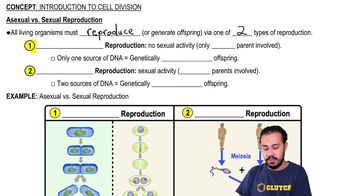
Reproduction of an organism that does not involve a second organism or sex cells. Individuals produced from asexual reproduction are referred to as clones.
What is sexual reproduction? What advantage does it provide to organisms?
two parents give rise to offspring that have unique combinations of genes inherited from the two parents. It provides more variation in genes which can provide more and better mutations to offspring.
What is a life cycle?
The generation-to-generation sequence of stages in the reproductive history of an organism.
What is a karyotype?
What is a homolog?
A display of the chromosome pairs of a cell arranged by size and shape.
A pair of chromosomes of the same length, centromere position, and staining pattern that possess genes for the same characters at corresponding loci. One homolog is inherited from each parent
What are sex chromosomes?
What are autosomes?
A chromosome responsible for determining the sex of an individual.
A chromosome that is not directly involved in determining sex; not a sex chromosome.
What is a "set of chromosomes"?
A complete set of DNA from one parent. It should only be one or two unless there's a creature that can have 3 parents.
What is meiosis?
A modified type of cell division in sexually reproducing organisms consisting of two rounds of cell division but only one round of DNA replication. It results in cells with half the number of chromosome sets as the original cell.
What is alternation of generations referring to?
A life cycle in which there is both a multicellular diploid form, the sporophyte, and a multicellular haploid form, the gametophyte; characteristic of plants and some algae.
What is synapsis in meiosis?
What is a synaptonemal complex?
The phase where two homologous chromosomes (one from each parent) are attached to each other
A zipper-like structure composed of proteins, which connects a chromosome to its homolog tightly along their lengths during part of prophase I of meiosis.
What are chiasmata?
The X-shaped, microscopically visible region where crossing over has occurred earlier in prophase I between homologous nonsister chromatids. Chiasmata become visible after synapsis ends, with the two homologs remaining associated due to sister chromatid cohesion.
What are recombinant chromosomes?
A chromosome created when crossing over combines DNA from two parents into a single chromosome.