 뒤로
뒤로Chemical context of life
 02:13
02:13
이 집합의 용어 (21)
Matter
Is anything that takes up space and has mass. It consists in chemical elements in pure form and in combinations called compounds
Atomic number
The number of protons in the nucleus of an atom
Atom
Is the smallest unit of matter that still retains the properties of an element.
Atom is divided in....
3 subatomic atoms
Compound
Is a substance that consists of two or more different elements that chemically combine.
Element
Is a substance that can not be broken to other substance by chemical reactions
Essential Elements
Is an element that an organism needs to live and function properly
Trace elements
Is an element that an organism needs in very small amounts.
What four elements make up 96% of all living matter?
CHON
Isotope
Atoms of the same element with different numbers of neutrons.
Proton
A subatomic particle with a single positive electrical charge
Neutron
A subatomic particle having no electrical charge (electrically neutral)
Where is located the protons, neutrons and electrons
The protons and neutrons are located in the atomic nucleus and the electrons are located in the orbiting nucleus
Atomic mass
Atomic mass is the total mass of an atom, measured in daltons.
Mass number
Is the # of neutrons and protons
Radioactive isotope
An isotope (an atomic form of a chemical element) that is unstable; the nucleus decays spontaneously, giving off particles and energy.
Energy
The capacity to cause change, especially to do work (to move matter against an opposing force).
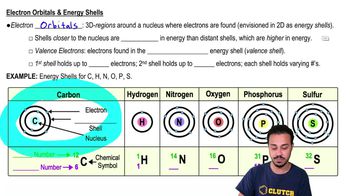
Electron shells
An energy level of electrons at a characteristic average distance from the nucleus of an atom.
What is the only subatomic particle that is directly involved in the chemical reactions between atoms?
Electrons
Valence electrons
An electron in the outermost electron shell.
Octet rule
Chemical rule that says that element lend to bond in a way that gives each atom 8 valence electrons, achieving a stable electron configuration like a noble gas