 뒤로
뒤로Chemical Context of Life - General Biology
 02:13
02:13
이 집합의 용어 (20)
An atom is the smallest unit of an element that retains its chemical properties.
An element is a substance made of only one type of atom. A molecule is two or more atoms held together by chemical bonds.
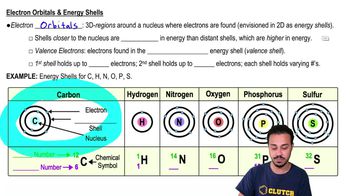
Electrons, especially the valence electrons in the outermost shell, determine how an atom bonds and reacts chemically.
Protons (positive), neutrons (neutral), and electrons (negative).
Atomic number is the number of protons in an atom. Mass number is the total number of protons and neutrons.
Isotopes are atomic forms of an element that differ in the number of neutrons but have the same number of protons.
Electrons are arranged in energy levels called electron shells. The first shell holds up to 2 electrons, the second up to 8, and so on.
Atoms with full outer electron shells are more stable and less reactive, while atoms with incomplete shells tend to form chemical bonds.
Electronegativity is the tendency of an atom to attract shared electrons in a covalent bond.
Nonpolar covalent bonds share electrons equally. Polar covalent bonds share electrons unequally, creating partial charges.
An ionic bond forms when electrons are transferred from one atom to another, creating oppositely charged ions that attract.
A hydrogen bond is a weak attraction between a partially positive hydrogen atom covalently bonded to an electronegative atom and another electronegative atom nearby.
Van der Waals interactions are weak attractions caused by temporary or permanent partial charges between molecules.
Water is polar because oxygen attracts shared electrons more strongly than hydrogen, creating partial negative and positive charges.
Hydrogen bonding gives water cohesion, adhesion, high specific heat, expansion upon freezing, and versatility as a solvent.
Cohesion is water molecules sticking to each other; adhesion is water sticking to other surfaces.
Specific heat is the energy needed to raise 1g of a substance by 1°C. Water's is high due to hydrogen bonds absorbing heat before temperature rises.
Evaporative cooling occurs when water evaporates, removing heat and cooling the surface, important for temperature regulation in organisms.
Ice is less dense than liquid water because hydrogen bonds hold molecules in a fixed, spaced arrangement, causing expansion upon freezing.
Hydrophilic substances interact well with water (usually polar or charged). Hydrophobic substances do not (usually nonpolar).