 뒤로
뒤로Descent with Modification - General Biology
 07:48
07:48
이 집합의 용어 (20)
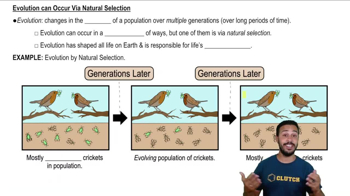
Evolution is the process by which species accumulate differences from their ancestors as they adapt to different environments over time.
Aristotle believed species were fixed and unchanging, arranging them on a scale of increasing complexity called the scala naturae.
Linnaeus developed a nested classification system grouping similar species into inclusive categories and introduced the binomial nomenclature for naming species.
Paleontology is the study of fossils, developed largely by Georges Cuvier, who observed that older strata contain less similar fossils and proposed catastrophic events caused species changes.
Hutton proposed gradual formation of geologic features; Lyell proposed that current geologic processes operate at the same rate as in the past, implying Earth is very old.
Lamarck proposed use and disuse (body parts used more become stronger) and inheritance of acquired characteristics, though this mechanism lacks experimental support.
Observation 1: Populations vary in inherited traits. Observation 2: Species produce more offspring than the environment can support, leading to competition.
Inference 1: Individuals with favorable traits produce more offspring. Inference 2: This leads to accumulation of favorable traits over generations.
As a tree of life with multiple branchings from a common ancestor, where branches represent groups of organisms and forks represent common ancestors.
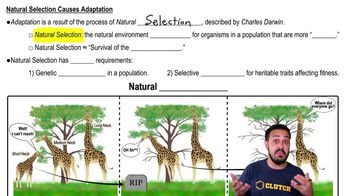
Artificial selection is human-driven breeding for desired traits, while natural selection is the environment favoring traits that increase survival and reproduction.
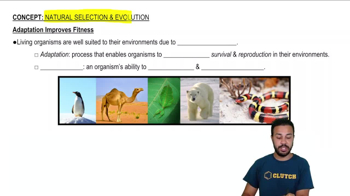
Adaptations are inherited characteristics that enhance an organism's survival and reproduction in specific environments.
Natural selection acts on heritable traits, increases favorable adaptations, populations evolve (not individuals), and it depends on environmental variability.
Evidence includes direct observations, homology, the fossil record, and biogeography.
Homology is similarity due to common ancestry, such as anatomical structures with different functions but similar underlying patterns.
Vestigial structures are remnants of features that served a function in ancestors but are reduced or nonfunctional in descendants.
Convergent evolution is the independent evolution of similar traits in distantly related groups due to adaptation to similar environments.
The fossil record shows extinction, origin of new groups, and transitional forms documenting evolutionary changes over time.
Biogeography studies species distribution influenced by continental drift, helping predict when and where groups evolved.
Species on different islands were similar but distinct, suggesting they diversified from mainland ancestors after colonization.
Strata contain fossils arranged by age, with older fossils in lower layers and younger fossils in upper layers, showing changes over time.